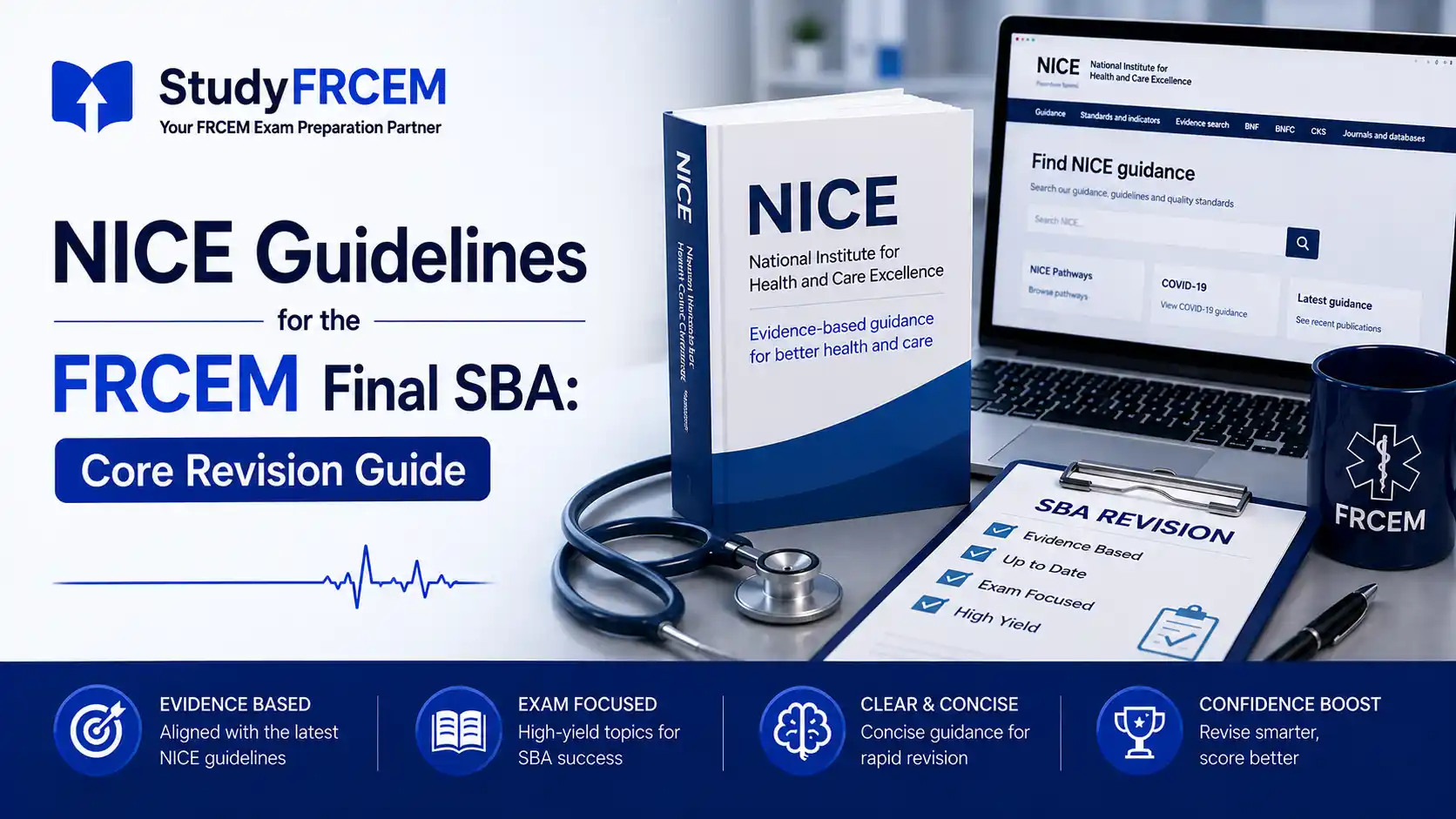

Ask any candidate who has sat the FRCEM Final SBA and they'll tell you the same thing: the hardest questions aren't the ones testing obscure conditions. They're the ones testing whether you know the current NICE guideline for a common condition — and whether your revision material is actually up to date.
That gap is where marks are lost. A question bank written a few years ago might still teach the old paracetamol two-line nomogram, the ABCD2 scoring system for TIA, or the two-letter ABCDE sequence for trauma. None of those reflects what NICE or the relevant guideline bodies currently say. And the FRCEM SBA, blueprinted against the RCEM 2021 curriculum, tests what's current — not what was current two years ago.
This guide cuts through the noise. Below, you'll find the most FRCEM-relevant NICE guidelines organised by clinical area, with the specific decision points, thresholds, and updates that actually appear in SBA questions. Use it to check your revision is aligned with what you'll actually be tested on.
Why NICE Guidelines Specifically?
The FRCEM Final SBA is explicitly designed to test management "in line with national best practice." For UK emergency medicine, that means NICE guidance sits at the top of the evidence hierarchy for most clinical decisions — not individual hospital protocols, not textbooks, and not anything written before the most recent major update.
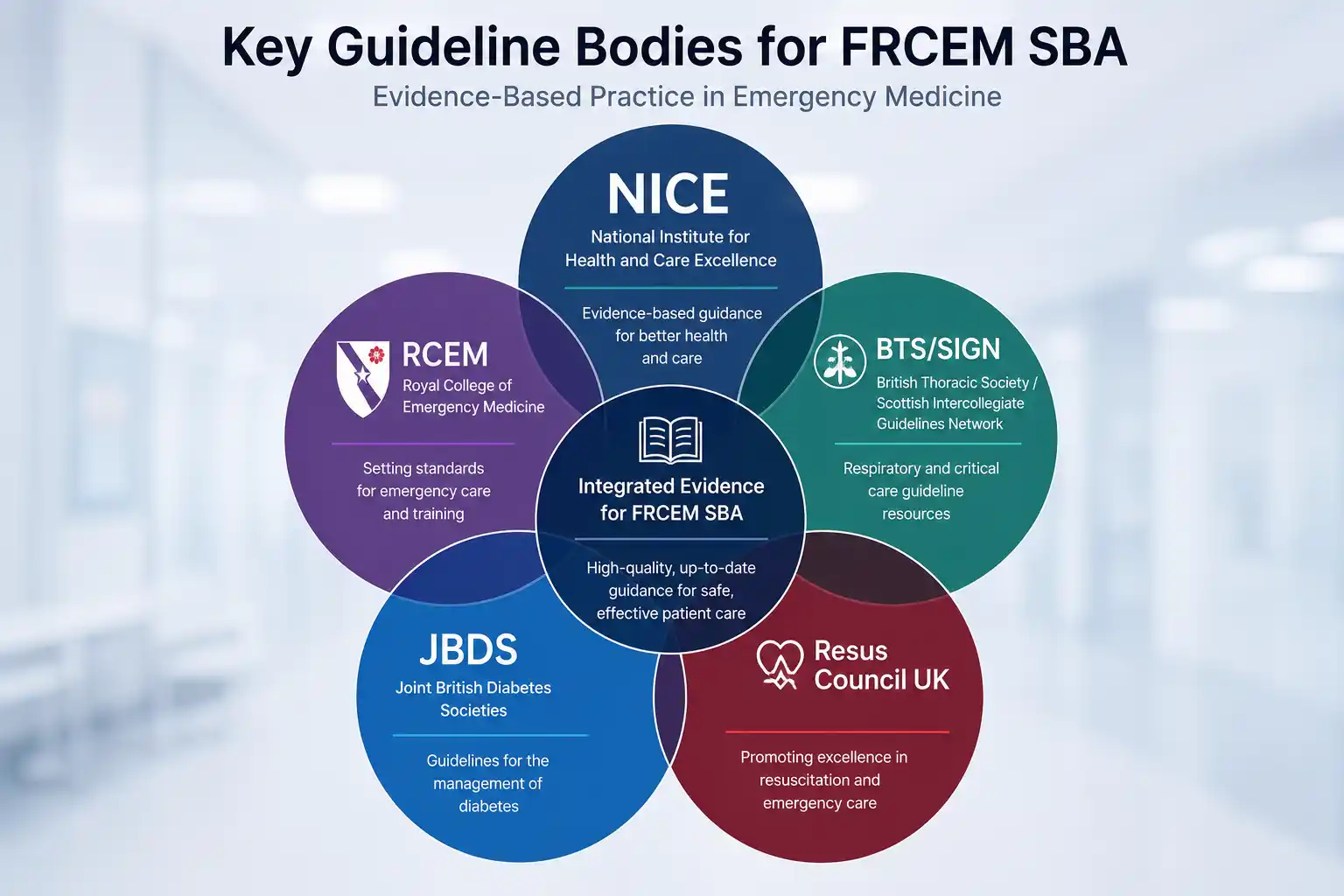
RCEM's own curriculum documentation directs candidates toward NICE, Resuscitation Council UK, and other national bodies as the standards against which SBA questions are benchmarked. That means if a NICE guideline has been updated, the exam reflects the new version. The old version is, by definition, the wrong answer.
The sections below cover every major NICE guideline relevant to the FRCEM Final SBA, noting where recent updates have changed the testable answer.
Head Injury: NICE NG232
Status: Updated. High exam priority.
NICE NG232 is the guideline for head injury assessment and early management. It replaced the older guidance and introduced changes that directly affect exam answers — most importantly, the GCS thresholds for immediate CT and a formalised pathway for anticoagulated patients.
The three adult CT pathways you must know:
Immediate CT (within 1 hour) — any one of:
GCS <13 on initial ED assessment
GCS <15 at 2 hours post-injury
Suspected open or depressed skull fracture
Any sign of basal skull fracture (Battle's sign, panda eyes, haemotympanum, CSF leak)
Post-traumatic seizure
Focal neurological deficit
More than one episode of vomiting
CT within 8 hours — loss of consciousness or amnesia plus any one of:
Age ≥65
Any clotting or bleeding disorder
Dangerous mechanism (pedestrian struck, ejected from vehicle, fall >1 metre or 5 stairs)
Retrograde amnesia >30 minutes
CT within 8 hours — anticoagulant/antiplatelet pathway (no other risk factors needed):
Any anticoagulant (DOAC, warfarin, heparin, LMWH)
Antiplatelet therapy — excluding aspirin monotherapy
TXA for head injury: 2g IV bolus for adults with GCS ≤12 and no active extracranial bleeding, given within 2 hours of injury, before imaging.
Key trap: The immediate CT GCS threshold is <13 for adults and <14 for children under 16 — these are different numbers. Confusing them is one of the most commonly tested errors. Aspirin monotherapy does not trigger the anticoagulant CT pathway.
For the full breakdown of every NG232 criterion with worked SBA scenarios, see the NICE NG232 head injury guide.
Acute Coronary Syndrome: NICE NG185 and ESC Guidelines
Status: Updated. Very high exam priority.
ACS is the single most heavily tested clinical topic in the FRCEM Final SBA, accounting for approximately 10–12 questions per sitting. NICE NG185 covers ACS management and aligns closely with the current ESC guidelines.
Key decision points FRCEM tests:
STEMI diagnostic threshold: ≥1mm ST elevation in two contiguous limb leads, or ≥2mm in precordial leads
PPCI time target: first medical contact to balloon within 120 minutes — not door-to-balloon 90 minutes (a different, in-hospital metric)
Preferred P2Y12 inhibitor for PCI: prasugrel over ticagrelor per current ESC guidance
Do not pre-treat with prasugrel or ticagrelor before coronary anatomy is known — Class III recommendation
Oxygen: only if SpO₂ <90% — routine high-flow oxygen is not recommended
High-sensitivity troponin: 0h/1h algorithm — a single normal troponin is never sufficient for discharge
NSTEMI early invasive strategy: now a Class IIa recommendation (should be considered) rather than Class I (mandatory)
STEMI equivalents requiring immediate cath lab activation: posterior MI (ST depression V1–V3, tall R waves), de Winter's T waves, new LBBB with symptoms.
For ECG interpretation detail and full management protocols, the FRCEM STEMI vs NSTEMI guide covers this comprehensively.
Stroke and TIA: NICE NG128 and National Clinical Guideline for Stroke
Status: Significantly updated. High exam priority.
This is the area where using outdated revision material does the most damage. Multiple key decisions have changed.
Most important update: ABCD2 scoring has been withdrawn. NICE and the National Clinical Guideline for Stroke explicitly state that scoring systems such as ABCD2 should not be used for TIA risk stratification, referral timing, or treatment decisions. All suspected TIA patients should be referred immediately for specialist assessment with MRI within 24 hours.
Other key current answers:
Decision point | Current answer |
|---|---|
TIA referral | Immediate specialist referral — no scoring system |
Thrombolysis window | 4.5 hours standard; extended to 9 hours for wake-up stroke with DWI-FLAIR mismatch |
Age restriction for thrombolysis | None — consider regardless of age or severity |
Thrombolytic options | Alteplase or tenecteplase |
BP before thrombolysis | Lower to <185/110 before administering |
BP in ischaemic stroke, no thrombolysis | Do not lower unless >220/120 |
Antiplatelet for TIA/minor stroke | Dual antiplatelet (aspirin + clopidogrel) for 21 days — not aspirin monotherapy |
Long-term antiplatelet | Clopidogrel monotherapy preferred over aspirin |
The FRCEM stroke and TIA SBA cases guide covers every updated decision point with worked scenarios.
Asthma: NICE NG244/NG245 and BTS/SIGN Acute Pathway
Status: Major update. Know the split.
NICE NG245, published in November 2024 jointly with BTS and SIGN, is the new collaborative asthma guideline. It covers diagnosing, monitoring and managing asthma in adults, young people and children — and it updates and replaces NICE NG80 and parts of BTS/SIGN SIGN 158.
A separate asthma pathway (NG244) supplements NG245 and includes evidence-based recommendations for the management of patients with asthma which are out of scope of the guideline — this is where acute asthma attacks sit. BTS and SIGN retain the recommendations on non-pharmacological management, managing acute attacks, and managing difficult asthma.
Why this split matters for FRCEM:
NG245 covers chronic management and diagnosis — relevant for SBA questions about diagnosis criteria, stepping up/down treatment, and monitoring. The separate BTS/SIGN acute asthma pathway covers what most FRCEM questions actually test: severity classification and ED management.
Acute asthma severity — what FRCEM tests:
Life-threatening features: PEF <33%, SpO₂ <92%, silent chest, cyanosis, altered consciousness, bradycardia, normal or rising PaCO₂ (≥4.6 kPa) — the last one is the most commonly missed
Acute severe: PEF 33–50%, RR ≥25, HR ≥110, unable to complete sentences
Escalation sequence: Salbutamol 5mg nebulised (oxygen-driven) → ipratropium 0.5mg → IV magnesium sulphate 1.2–2g over 20 minutes → senior/ICU review
IV aminophylline is not a routine step — senior/ICU decision only
Oxygen target in asthma: 94–98% (unlike COPD)
Key trap: Normal CO₂ in acute severe asthma is a life-threatening sign, not a reassuring one. The patient is tiring. This comes up repeatedly in exam scenarios.
For COPD, the oxygen target changes to 88–92% via Venturi mask, and NIV is indicated at pH <7.35 with type 2 respiratory failure. The FRCEM asthma and COPD guide covers both conditions with the full escalation algorithms.
DKA and HHS: JBDS 02 and JBDS 06
Status: Updated. Specific numbers are tested.
The Joint British Diabetes Societies guidelines are the NICE-endorsed standards for DKA and HHS management in UK hospitals. Two updates specifically affect exam answers.
DKA — what's changed and what's tested:
Diagnostic criteria: glucose >11 mmol/L, ketones >3 mmol/L, pH <7.3 or bicarbonate <15 mmol/L
Fluids before insulin — always
FRIII starting rate: 0.1 units/kg/hour
Updated: When glucose falls to ≤14 mmol/L, reduce FRIII to 0.05 units/kg/hour and add 10% glucose alongside — do not continue at 0.1 units/kg/hour
Continue long-acting insulin throughout
Resolution: pH >7.3, bicarbonate >15, ketones <0.6 mmol/L — not glucose normalisation
Euglycaemic DKA: seen in patients on SGLT-2 inhibitors — glucose may be near-normal despite ketoacidosis
HHS — what's different:
Glucose ≥30 mmol/L, osmolality ≥320 mOsm/kg, no significant ketosis (ketones ≤3 mmol/L)
Correction over 24–72 hours — much slower than DKA
Withhold insulin initially — fluids alone should lower glucose; only start FRIII if ketones rising or glucose not falling
Treatment-dose LMWH — not just prophylactic dose (unique to HHS)
Full protocols and worked scenarios are in the FRCEM DKA and HHS management guide.
AKI and Hyperkalaemia: NICE NG148 and UK Kidney Association Guidance
Status: Updated. Dosing change — high exam risk.
NICE NG148 covers acute kidney injury prevention, detection and management. AKI staging is tested via KDIGO criteria:
Stage 1: creatinine 1.5–1.9× baseline, or rise ≥26.5 μmol/L within 48 hours
Stage 2: 2.0–2.9× baseline
Stage 3: ≥3× baseline, creatinine ≥354 μmol/L, or RRT required
Hyperkalaemia — critical dosing update:
The UK Kidney Association updated its guidance following an MHRA safety review. The calcium dose has changed:
Cardiac protection: IV calcium gluconate — updated recommended dose is 30 ml of 10% calcium gluconate over 10 minutes (not 10 ml as older resources teach). Use calcium chloride in cardiac arrest or peri-arrest.
Shift K⁺ intracellularly: 10 units soluble insulin in 25g glucose IV; nebulised salbutamol 10–20mg as adjunct
Monitor glucose: at 0, 15, 30 minutes, then hourly for 6 hours — delayed hypoglycaemia is a recognised complication
Remove K⁺: dialysis for refractory cases; potassium binders (sodium zirconium cyclosilicate) for non-acute adjunct use
Emergency dialysis indications — AEIOU: Acidosis, Electrolyte disturbance (refractory K⁺), Intoxication (lithium, methanol, salicylates), Overload (pulmonary oedema), Uraemia (encephalopathy, pericarditis).
The FRCEM AKI and electrolyte emergencies guide has the full updated protocol and worked questions.
Paracetamol Overdose: MHRA/CHM Guidance and RCEM SNAP Protocol
Status: Updated. Two-line nomogram is obsolete.
The MHRA/Commission on Human Medicines guideline change is one of the most consequential updates for FRCEM toxicology questions.
Single treatment line at 100 mg/L at 4 hours — the old two-line risk-factor system (with a lower threshold for "high-risk" patients) has been withdrawn
Staggered overdose or unknown timing: give NAC immediately — do not use the nomogram
NAC efficacy is near 100% within 8 hours of ingestion; falls substantially after this
SNAP regime (12-hour, RCEM-endorsed) is an established alternative to the standard 21-hour 3-bag regime
NAC hypersensitivity reactions: pause, treat, restart — not a contraindication to continuing treatment
Continue NAC beyond planned regime if ALT rising or INR >1.3
For TCA overdose alongside paracetamol: ECG QRS >100 ms and terminal R wave in aVR indicate TCA toxicity requiring sodium bicarbonate targeting pH 7.45–7.55. Phenytoin and flumazenil are both contraindicated in TCA management.
Full protocols are in the FRCEM paracetamol and TCA overdose guide.
Sepsis: NICE NG51 and Surviving Sepsis Campaign
Status: Stable but frequently tested.
NICE NG51 defines the UK standard for sepsis recognition and management. The Sepsis-3 definition applies: life-threatening organ dysfunction from a dysregulated host response to infection, with SOFA score ≥2. Septic shock: vasopressor requirement for MAP ≥65 mmHg plus lactate >2 mmol/L despite adequate fluid resuscitation.
Sepsis-6 bundle (within 1 hour):
Blood cultures — before antibiotics
IV broad-spectrum antibiotics — within 1 hour of recognition
IV fluid bolus — 500 ml crystalloid, reassess after each bolus
Serum lactate measurement
Urine output monitoring
High-flow oxygen targeting SpO₂ ≥94%
Vasopressor of choice in septic shock: noradrenaline. Lactate >4 mmol/L = septic shock regardless of BP.
The most commonly tested decision: blood cultures first, then antibiotics without delay. Do not defer antibiotics while waiting for imaging.
Major Trauma: ATLS 11th Edition and NICE NG232
Status: Updated. xABCDE sequence — high exam priority.
The ATLS 11th edition formalised the xABCDE sequence — the x represents exsanguinating haemorrhage control (tourniquet, wound packing, pelvic binder) as the first priority before airway assessment when catastrophic external bleeding is present.
Other key current answers:
Decision point | Current answer |
|---|---|
Primary survey sequence | xABCDE (not ABCDE) |
Massive transfusion ratio | 1:1:1 (RBC:FFP:platelets) |
TXA for major haemorrhage | 1g bolus + 1g infusion within 3 hours |
TXA for isolated head injury (GCS ≤12) | 2g bolus within 2 hours, before imaging |
Permissive hypotension | SBP 80–90 mmHg in penetrating trauma without head injury |
GCS threshold for intubation | ≤8 |
Tension pneumothorax | Clinical diagnosis — immediate needle decompression, no CXR |
The FRCEM ATLS primary survey guide covers xABCDE in full with worked scenarios.
Resuscitation: Resuscitation Council UK ALS Guidelines
Status: Stable core; recent paediatric updates.
The Resuscitation Council UK ALS guidelines underpin SLO3 — the single highest-weighted SLO in the FRCEM Final SBA with approximately 40 questions.
Core ALS algorithm:
Shockable (VF/pVT): defibrillate + CPR; adrenaline 1mg after 3rd shock; amiodarone 300mg after 3rd shock
Non-shockable (PEA/asystole): CPR + adrenaline 1mg as soon as IV/IO access
4Hs: Hypoxia, Hypovolaemia, Hypo/hyperkalaemia, Hypothermia
4Ts: Tension pneumothorax, Tamponade, Toxins, Thromboembolism
Post-ROSC: targeted temperature management, 12-lead ECG, PCI if STEMI identified
Paediatric updates: Key RCUK updates for paediatric resuscitation are now included in current exam revision priorities - know that paediatric ALS uses 4J/kg for defibrillation and adrenaline 10 micrograms/kg IV/IO.
The FRCEM Final SBA is, in significant part, a test of how current your guideline knowledge is. The clinical reasoning rarely changes dramatically from year to year - but the specific numbers, thresholds, and first-line answers do, and that's exactly where the exam separates candidates who have revised strategically from those who haven't.
Use this guide to audit your current revision against the live standards, identify where your notes might be out of date, and make sure every answer you select reflects what NICE and the relevant guideline bodies actually say right now.
For SLO-mapped practice questions built against every guideline covered on this page, register with StudyFRCEM and access a question bank updated to reflect current UK guidance.
Frequently Asked Questions
Do I need to read the full NICE guideline documents?
No. FRCEM tests the clinical decision points these guidelines produce, not document-level detail. The summaries above, combined with the topic-specific guides linked throughout, cover what's tested.
What if my revision notes disagree with what's above?
Trust the current guideline. If you see a conflict, identify which source is more recent. For the areas flagged as "updated" above, the change is real and the exam reflects the newer version.
How often do NICE guidelines change?
Major guidelines are reviewed on multi-year cycles, but updates can happen at any point. The FRCEM SBA is written to reflect current published guidance — so a guideline updated six months before your sitting is already fair game.
Are all NICE guidelines equally weighted?
No. Guidelines that underpin high-volume SLOs — particularly SLO3 (resuscitation, ~40 questions) and SLO1 (complex presentations, ~35 questions) - carry the most marks. Prioritise those first.