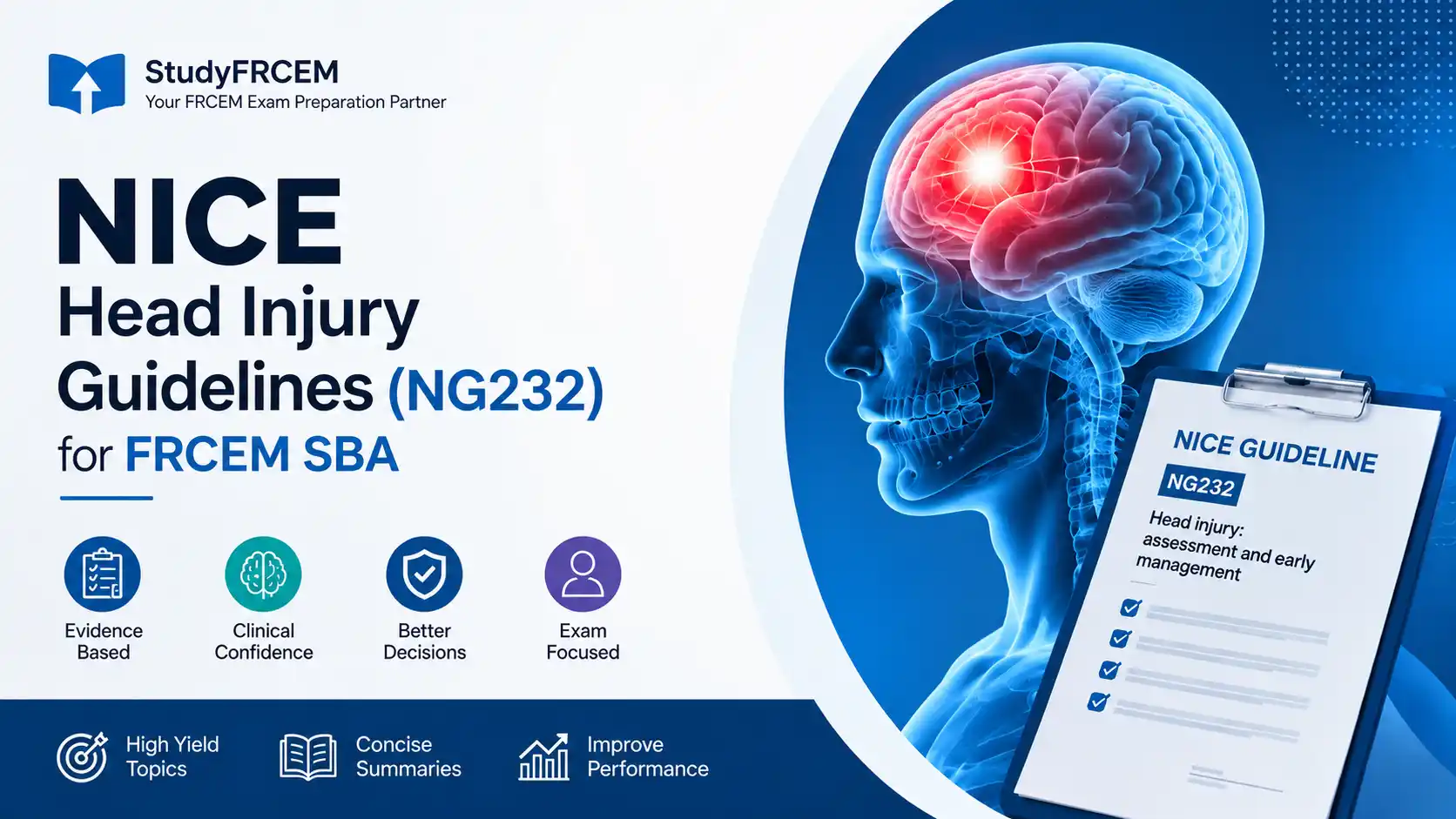

Head injury is one of the few FRCEM topics where the correct answer isn't really a clinical judgement call — it's a checklist. NICE NG232 gives you the exact risk factors, the exact time windows, and the exact thresholds. Get them memorised precisely and these questions become some of the fastest marks in the exam. Get them slightly wrong — confuse the 1-hour list with the 8-hour list, or forget the anticoagulant pathway — and you'll talk yourself into the wrong answer with total confidence.
NG232 replaced the older head injury guidance, and it introduced changes that genuinely matter for the exam: a revised GCS threshold, a dedicated anticoagulant/antiplatelet pathway, and formal guidance on tranexamic acid that didn't exist in older versions. This guide breaks down exactly what FRCEM tests from NG232, with the precise criteria you need memorised.
Why NG232 Specifically Matters for FRCEM
NICE NG232, published in 2023, covers assessment and early management of head injury across babies, children, young people, and adults. It replaced the long-standing earlier guideline and refined several of the decision points that question writers love to test — particularly the criteria for who gets an immediate CT, who can wait 8 hours, and how anticoagulation changes the pathway.
If your revision notes were written before this update, you may be working from criteria that have since shifted. The most consequential change for FRCEM purposes: the GCS threshold for immediate CT moved, and a specific anticoagulant/antiplatelet pathway was formalised that didn't exist as clearly in older guidance.
The Three CT Head Pathways — Know Which List a Patient Falls Into
NG232 effectively creates three separate criteria lists for adults (16 and over). FRCEM tests whether you can correctly sort a clinical scenario into the right list — this is the single most important skill for this topic.
Pathway 1: CT Within 1 Hour (Immediate)
Any one of the following triggers an immediate CT:
GCS less than 13 on initial assessment in the emergency department
GCS less than 15 at 2 hours after the injury, on assessment in the ED
Suspected open or depressed skull fracture
Any sign of basal skull fracture — haemotympanum, panda eyes (periorbital bruising), CSF leak from the ear or nose, Battle's sign
Post-traumatic seizure
Focal neurological deficit
More than one episode of vomiting since the injury
Exam-critical detail: the immediate-CT threshold is GCS <13, not GCS <14 and not GCS <15. This number gets confused constantly in revision — lock in "13" specifically for the immediate pathway.
Pathway 2: CT Within 8 Hours (Loss of Consciousness or Amnesia + Risk Factor)
This pathway applies to patients who have had some loss of consciousness or amnesia since the injury and have any one of these additional risk factors:
Age 65 or over
Any current bleeding or clotting disorder
Dangerous mechanism of injury — pedestrian or cyclist struck by a vehicle, occupant ejected from a vehicle, or a fall from a height of more than 1 metre or 5 stairs
More than 30 minutes of retrograde amnesia of events immediately before the injury
If the patient presents more than 8 hours after the injury and meets these criteria, the CT should be done within 1 hour of presentation rather than waiting out the remainder of the 8-hour window.
Pathway 3: CT Within 8 Hours — Anticoagulant or Antiplatelet Treatment (No Other Risk Factors)
This is the pathway most likely to be tested as an "update" question, because it didn't exist in this explicit form in older guidance.
For people with a head injury, no other indication for CT, but who are on anticoagulant treatment (vitamin K antagonists, DOACs, heparin, LMWH) or antiplatelet treatment (excluding aspirin monotherapy), NICE NG232 recommends considering a CT head scan within 8 hours of the injury — or within the hour if they present more than 8 hours after the injury — even without any other risk factor present.
Why this is tested separately: anticoagulated patients can develop a delayed intracranial bleed that wasn't apparent at initial assessment. The rationale explicitly notes this group needs scanning even when the rest of the assessment looks reassuring, because intracranial bleeding can be occult early and these patients may not reliably return if they deteriorate later.
FRCEM trap: Aspirin monotherapy is specifically excluded from this pathway. A patient on aspirin alone, with no other risk factors, does not automatically qualify for CT under this rule — but a patient on aspirin plus clopidogrel (dual antiplatelet therapy) does.
GCS: The Threshold That Trips People Up
Because GCS appears in two different pathways with two different numbers, this is one of the most commonly confused points in the entire guideline.
Scenario | GCS threshold | Pathway |
|---|---|---|
Initial assessment in ED | <13 | Immediate CT (1 hour) |
Reassessment at 2 hours post-injury | <15 | Immediate CT (1 hour) |
GCS ≤12 | — | Consider TXA (see below) |
GCS ≤8 | — | Early advanced airway management; pre-alert the receiving ED |
Notice that the initial GCS threshold for immediate CT is 13, but the threshold at the 2-hour reassessment drops to 15 — meaning any patient who hasn't fully returned to a normal GCS by 2 hours needs an immediate scan, even if they only started at GCS 14. This distinction between the two timepoints is exactly the kind of detail FRCEM builds a question around.
Tranexamic Acid: A Newer Addition Worth Knowing Precisely
TXA guidance for head injury wasn't this explicit in older versions of the guideline, which makes it a high-yield "what's changed" topic.
For people with a head injury and a GCS score of 12 or less who are not thought to have active extracranial bleeding, NG232 recommends considering a 2 g intravenous bolus of tranexamic acid for adults (16 and over), given as soon as possible and within 2 hours of the injury, in either the pre-hospital or hospital setting, and before imaging.
Key numbers:
GCS ≤12 — the threshold for considering TXA
2 g IV bolus — for adults
Within 2 hours of injury — the time window
Before imaging — don't wait for the CT to give it
No active extracranial bleeding required to qualify — TXA is given for the head injury itself, not because of visible bleeding elsewhere
If the patient does have suspected or confirmed extracranial bleeding alongside the head injury, manage TXA according to the major trauma haemostatic agents pathway instead — which uses a different dosing structure for haemorrhage control.
FRCEM trap: Don't confuse this with the major trauma TXA regime (1 g bolus + 1 g infusion over 8 hours, used for haemorrhagic shock). Isolated head injury with GCS ≤12 and no extracranial bleeding uses a single 2 g bolus with no infusion. For the full haemorrhage-control TXA protocol, see the FRCEM ATLS and primary survey guide.
Initial Priorities Before Any CT Decision
NG232 is explicit that the CT criteria only apply once the basics are addressed. The priority for anyone presenting to the ED is to stabilise airway, breathing, and circulation before attending to other injuries — head injury assessment doesn't override the primary survey.
Other points NG232 makes about initial assessment:
A reduced conscious level should only be attributed to intoxication once a significant traumatic brain injury has been excluded — alcohol or drugs are never an acceptable reason to skip CT criteria assessment in a head-injured patient with a reduced GCS
Anyone presenting to the ED with a head injury should be assessed by a trained member of staff within 15 minutes of arrival
For GCS ≤8, ensure early involvement of a clinician trained in advanced airway management
Pre-alert the receiving department for any patient with a GCS of 8 or less
Children Under 16: Key Differences
NG232 covers paediatric head injury with a parallel but distinct set of criteria — FRCEM does test some paediatric-specific points, even in adult-focused revision.
Immediate CT (within 1 hour) if any one of:
Suspicion of non-accidental injury
Post-traumatic seizure without history of epilepsy
GCS less than 14 on initial assessment in the ED (or, for babies under 1, a paediatric GCS less than 15)
At 2 hours, a GCS less than 15
Suspected open or depressed skull fracture, or tense fontanelle
Any sign of basal skull fracture
Focal neurological deficit
For babies under 1 year, a bruise, swelling, or laceration of more than 5 cm on the head
Note the GCS difference: the immediate-CT threshold for children is GCS <14, not <13 as in adults. This is a deliberately different number and a common point of confusion.
If a child has more than one of a separate list of lower-tier risk factors (witnessed loss of consciousness >5 minutes, abnormal drowsiness, dangerous mechanism, amnesia, etc.) without meeting the criteria above, they should still receive a CT within 1 hour — multiple lower-risk features combine to the same urgency as a single high-risk feature.
Observation alternative for children with only one risk factor: if a child has just one of the lower-tier risk factors and none of the immediate criteria, observe for a minimum of 4 hours from the time of injury. If any new risk factor develops during observation, proceed to CT within 1 hour.
Admission Criteria After Imaging
NG232 also sets out who should be admitted once imaging is complete — this is tested less often but worth knowing in outline.
Admit if there are:
New, clinically important abnormalities on imaging (an isolated, simple, linear, non-displaced skull fracture is usually not considered clinically important — unless the patient is anticoagulated)
A GCS that hasn't returned to 15 (or pre-injury baseline) after imaging
Indications for CT scanning but CT not yet available, or the scan is technically inadequate
Continuing concerns (drowsiness, vomiting, severe headache) about the patient's condition following review
Common FRCEM Mistakes
1. Using GCS <14 or <15 for the adult immediate-CT threshold The correct adult threshold is GCS <13 on initial assessment. <14 is the paediatric threshold — mixing the two up is one of the most common errors.
2. Forgetting the anticoagulant pathway exists independently A patient on a DOAC with a normal GCS and no other risk factors still needs a CT within 8 hours. This pathway exists specifically because these patients can deteriorate later from an initially occult bleed.
3. Including aspirin monotherapy in the anticoagulant pathway Aspirin alone does not trigger the dedicated anticoagulant/antiplatelet CT pathway. Dual antiplatelet therapy (e.g. aspirin + clopidogrel) does.
4. Confusing the two TXA regimes 2 g single bolus for isolated head injury (GCS ≤12, no extracranial bleeding, within 2 hours) is different from the 1 g bolus + 1 g infusion regime used for major haemorrhage. Don't apply the haemorrhage protocol to a head-injury-only scenario.
5. Attributing reduced GCS to intoxication prematurely NG232 is explicit: only assume intoxication is the cause of reduced consciousness once a significant traumatic brain injury has been excluded. A drunk patient with a head injury still needs full assessment against the CT criteria.
6. Missing the 2-hour reassessment rule A patient who presented at GCS 14 and is still GCS 14 at the 2-hour mark needs an immediate CT — because the threshold at 2 hours is <15, not <13. This is frequently missed because candidates assume the initial threshold still applies at reassessment.
Put Your Knowledge to the Test
Reading about guideline updates is one thing, but applying them under time pressure against expert-level distractors is exactly how the FRCEM SBA tests your clinical reasoning.
Can you spot the difference between an initial GCS drop and a 2-hour reassessment failure? Do you know exactly when to withhold a CT scan for a patient on antiplatelet therapy?
Stop passively reading and start actively testing your exam technique. Our comprehensive FRCEM SBA question bank covers every single curriculum topic — from these precise trauma decision rules to complex toxicology, electrolyte emergencies, and beyond.
👉 Take a Free Demo Quiz or Register to Unlock the Full Question Bank
Study Strategy
NG232 rewards rote memorisation more than clinical reasoning — the numbers are fixed and the scenarios are designed to test whether you've got them exactly right.
Priority order for revision:
The three adult CT pathways (immediate / 8-hour with LOC or amnesia / anticoagulant-specific)
GCS thresholds: <13 initial (adult), <15 at 2 hours, <14 initial (paediatric)
TXA: GCS ≤12, 2 g bolus, within 2 hours, before imaging, no extracranial bleeding needed
Aspirin monotherapy exclusion from the anticoagulant pathway
Paediatric lower-tier risk factors and the 4-hour observation alternative
This pairs naturally with trauma primary survey revision — head injury decisions sit downstream of the xABCDE framework, and several of the same TXA and GCS concepts overlap. For a broader view of how this fits into your overall exam strategy, the RCEM clinical guidelines cheat sheet cross-references this topic against other major guideline updates.
NG232 is one of the most number-precise topics in the entire FRCEM curriculum — there's very little room for clinical interpretation once you know the criteria. Get the three CT pathways sorted correctly, lock in the GCS thresholds for both timepoints, and know the TXA criteria exactly, and head injury questions become some of the most reliable marks available.
For SLO-mapped trauma and head injury questions with detailed guideline-referenced explanations, register with StudyFRCEM.
Frequently Asked Questions
Is NG232 the same as the older head injury guideline I might have revised from?
No — NG232 was published as an update and includes revised criteria, including the GCS thresholds and the explicit anticoagulant/antiplatelet pathway and TXA guidance discussed above. If your notes predate this, cross-check the numbers.
Do I need to memorise the full list of "dangerous mechanism" criteria?
Yes — pedestrian or cyclist struck by a vehicle, occupant ejected from a vehicle, and fall from more than 1 metre or 5 stairs are specific enough that they appear verbatim in exam scenarios.
Does NG232 apply the same way to children as adults?
The structure is similar (immediate vs delayed CT pathways) but several specific numbers differ — most notably the paediatric GCS threshold of <14 versus the adult <13.
How many head injury questions appear in FRCEM?
Head injury is typically embedded within the broader trauma topic, which contributes 8–10 questions overall; head-injury-specific CT criteria questions appear in most sittings given how precisely testable the numbers are.
Is the TXA guidance definitely tested?
Given that it's one of the more recent additions to the guideline and has very specific, testable numbers (GCS ≤12, 2 g, within 2 hours), it's a strong candidate for exam questions looking to test current knowledge versus outdated revision material.