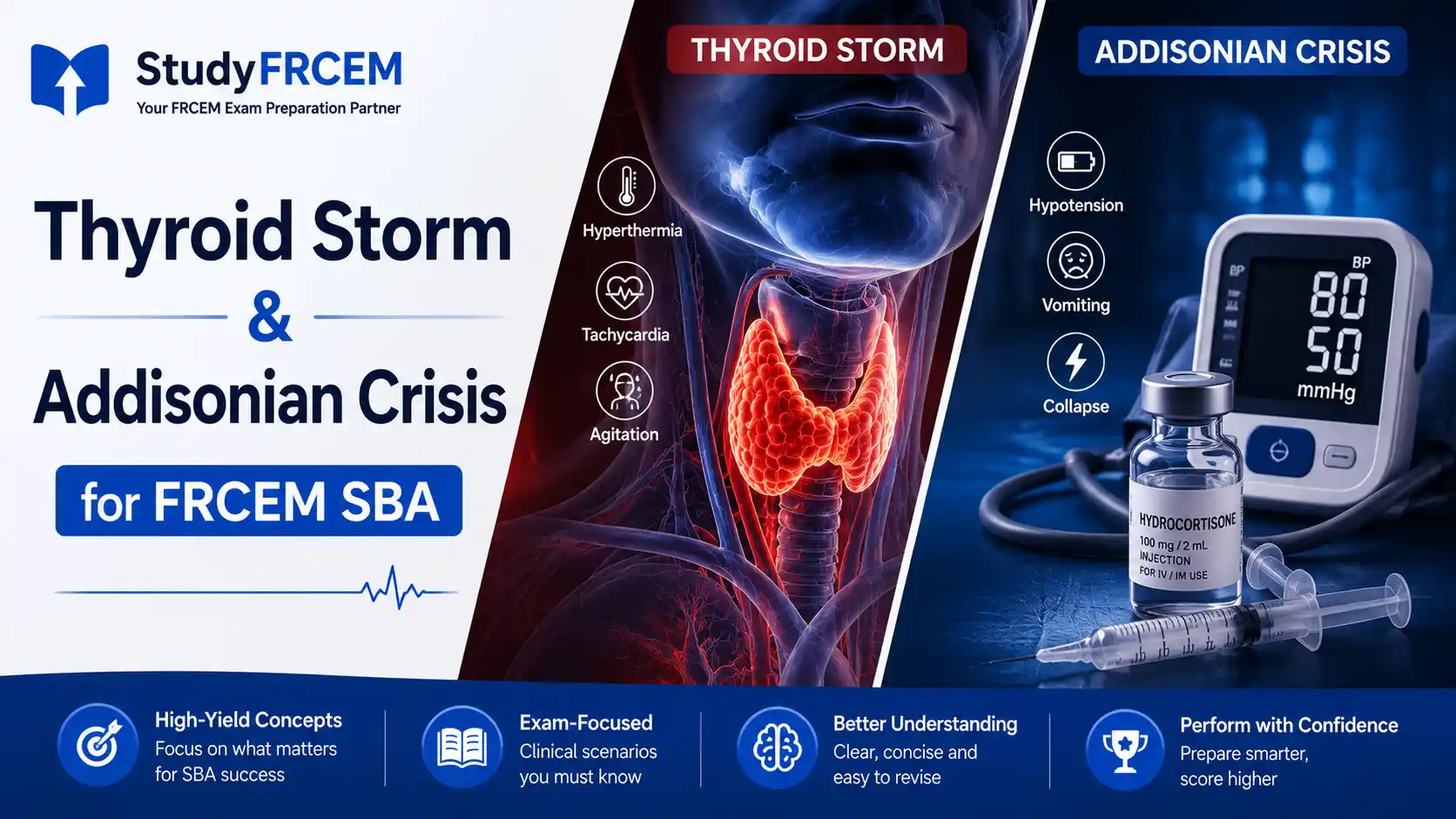

Thyroid storm and Addisons crisis are two of the most lethal of the presentations you’ll be tested on in the FRCEM SBA exam and also make up a small but high-yield section of the exam. Both are uncommon, and both end quickly if not treated, and both are often employed by examiners to see if you'll treat a patient clinically instead of waiting for lab results!
The challenge with these topics isn't memorizing obscure trivia—it's knowing the exact sequence of treatment steps, the scoring systems examiners love to quote, and the precipitants that turn a stable endocrine patient into a crashing one. This guide covers both conditions the way the FRCEM SBA actually tests them, referencing the Burch-Wartofsky Point Scale for thyroid storm and NICE NG243 (2026) for adrenal insufficiency and adrenal crisis.
Thyroid Storm: Recognition and Diagnosis
Thyroid storm is an extreme, life-threatening exacerbation of thyrotoxicosis. It is rare (1-2% of patients with known hyperthyroidism) but is fatal in 10-30% of patients, so the early recognition of it is very important, more important than the statistics would indicate.
Typical patients: Hyperthyroidism, either known or previously undiagnosed (Graves' disease being the usual underlying cause), with a sudden, dramatic deterioration.
Classic precipitants examiners test:
Infection or sepsis
Thyroid or non-thyroidal surgery
Iodinated contrast exposure
Trauma
Abrupt withdrawal of anti-thyroid medication
Diabetic ketoacidosis
Parturition (childbirth)
Clinical features:
Fever, often >38.5°C
Marked tachycardia, sometimes with new atrial fibrillation
Agitation, delirium, psychosis, or coma
Nausea, vomiting, diarrhoea, jaundice
Signs of high-output cardiac failure in severe cases
Exam point: There is no single biochemical test that confirms thyroid storm. TFTs will show a thyrotoxic pattern (low TSH, high free T4/T3), but the diagnosis is clinical, made using a scoring tool — not a lab cut-off.
The Burch-Wartofsky Point Scale (BWPS)
This is the tool the FRCEM loves to reference, even indirectly. It assigns points for thermoregulatory dysfunction, central nervous system effects, gastrointestinal-hepatic dysfunction, cardiovascular dysfunction such as tachycardia, atrial fibrillation, and heart failure, and the presence of a precipitating event.
Scoring bands:
BWPS Score | Interpretation |
≥45 | Highly suggestive of thyroid storm; manage aggressively, ICU-level care |
25–44 | Suggests an impending storm; consider thionamides and close monitoring |
<25 | Thyroid storm is unlikely; look for an alternative cause of thyrotoxicosis |
FRCEM angle: A question may give you a vignette with a fever, HR 135, agitation, and diarrhoea, then ask what to do next. You don't need to calculate the exact score—you need to recognize that this clinical picture crosses the "impending or established storm" threshold and requires immediate multi-modal treatment, not "awaiting TFT results."
Thyroid Storm: Management Steps
Treatment follows a specific order, and the sequence is a favourite exam trap.
Step 1: Beta-blockade
Controls the adrenergic symptoms (tachycardia, tremor, agitation) fast.
Propranolol 40–80 mg is typically given every 4 to 6 hours
Caution: propranolol can precipitate cardiogenic shock in patients with decompensated heart failure — use esmolol instead in this group, or diltiazem/verapamil if beta-blockade is contraindicated.
Step 2: Thionamide (anti-thyroid drug)
Start propylthiouracil (PTU) 200–250 mg orally every 4 hours, or methimazole/carbimazole 20–25 mg every 4 hours
PTU is preferred in thyroid storm because it additionally blocks peripheral T4-to-T3 conversion
Step 3: Iodine (only after the thionamide)
Critical exam trap: Wait at least 1 hour after the anti-thyroid drug before giving iodine—giving iodine first can actually fuel further hormone synthesis. This sequencing (thionamide → wait → iodine) is one of the most commonly tested details in this topic.
Given as potassium iodide (SSKI) or Lugol's solution once the wait period has passed
Step 4: Corticosteroids
Steroids decrease T4-to-T3 conversion in tissues and provide adrenal support, which can be impaired in thyroid storm
Hydrocortisone is typically given alongside the above steps, not held back
Step 5: Supportive care
Paracetamol for fever
Avoid aspirin—it displaces T4 from thyroid-binding globulin and raises free T4 further
IV fluids, cooling measures, and correction of electrolyte disturbances
ICU admission for BWPS ≥45 or haemodynamic instability
Thyroid Storm Complications
High-output cardiac failure — from prolonged, severe tachycardia
Atrial fibrillation with rapid ventricular response
Multi-organ failure in untreated or delayed cases
Thyroid storm-induced hepatic dysfunction — jaundice is a recognized feature, not an incidental finding
Addisonian Crisis: Recognition and Precipitants
Addisonian crisis (acute adrenal crisis) is the decompensated end of adrenal insufficiency—a state of absolute or relative cortisol deficiency that can rapidly become fatal if unrecognised.
Who's at risk:
Known Addison's disease (primary adrenal insufficiency)
Congenital adrenal hyperplasia
Hypothalamic-pituitary disease affecting ACTH production
Patients on long-term exogenous steroids who stop abruptly or fail to increase their dose during illness
Classic precipitants:
Infection or sepsis
Surgery or trauma
Abrupt cessation of steroid therapy
Vomiting or diarrhoea preventing oral steroid absorption
Physiological stress without an appropriate steroid "sick day" dose adjustment
Clinical features:
Profound hypotension, often refractory to fluids alone
Nausea, vomiting, abdominal pain
Hypoglycaemia
Confusion, lethargy, or coma
Hyponatraemia and hyperkalaemia in bloods (in primary adrenal insufficiency, due to mineralocorticoid loss)
Exam point: Look out for a patient on long-term steroids (for asthma, COPD, rheumatoid arthritis) who has recently had their dose reduced, missed doses due to illness, or undergone surgery without steroid cover. This history is often the key clue in the stem.
Addisonian Crisis: Management (NICE NG243)
The core principle, repeated across every UK guideline on this topic, is to treat first, investigate second.
If adrenal crisis is suspected, treat first: give 100 mg hydrocortisone IM/IV immediately, start urgent transfer, and arrange fluid resuscitation. Do not delay treatment while waiting for labs.
Immediate steps:
Hydrocortisone 100 mg IV or IM immediately — do not wait for cortisol or ACTH results
IV fluid resuscitation with 0.9% sodium chloride to correct hypotension
Correct hypoglycaemia if present (IV glucose)
Continue hydrocortisone — maintained at a dose of 200 mg per 24 hours, typically as a continuous infusion or 50 mg IV/IM every 6 hours
Identify and treat the precipitant — septic screen, review of steroid compliance, etc.
Blood tests before treatment (if it doesn't delay hydrocortisone):
Cortisol and ACTH (before the first hydrocortisone dose, if feasible without delay)
U&Es, glucose
Key FRCEM message: Diagnostic measures should never delay treatment—if adrenal crisis is suspected, treatment should be initiated without delay. A question showing a hypotensive patient on long-term steroids with a plausible precipitant is testing whether you'll give hydrocortisone immediately, not whether you'll wait for a synacthen test.
Diagnostic thresholds (NICE NG243, useful background knowledge):
Morning cortisol <150 nmol/L → likely adrenal insufficiency
150–300 nmol/L → uncertain, needs further testing
300 nmol/L → adrenal insufficiency very unlikely
Addisonian Crisis Complications
Refractory hypotension and shock if hydrocortisone is delayed
Severe hypoglycaemia, particularly in children
Cardiac arrhythmias secondary to hyperkalaemia
Death—adrenal crisis remains a preventable cause of mortality when recognition is delayed
Thyroid Storm vs Addisonian Crisis: Key Differences
Feature | Thyroid Storm | Addisonian Crisis |
Underlying problem | Excess thyroid hormone | Cortisol deficiency |
Typical vital sign pattern | Fever, tachycardia, hypertension or normal BP initially | Hypotension, often refractory to fluids |
Glucose | Usually normal or raised | Often low |
Key sodium/potassium pattern | Usually normal | Hyponatraemia + hyperkalaemia (primary AI) |
First-line drug | Propranolol (or esmolol) | Hydrocortisone 100 mg IV/IM |
Diagnostic tool | Burch-Wartofsky Point Scale | Clinical suspicion + cortisol/ACTH (don't wait for results) |
Steroid role | Adjunct (reduces T4→T3 conversion) | Primary, life-saving treatment |
Common precipitant | Infection, surgery, iodine exposure | Infection, steroid non-compliance, surgery |
Common FRCEM Exam Traps
Trap 1: Giving iodine before the thionamide in thyroid storm
Immediately administer anti-thyroid agent, then wait 1 hour before administering iodine. It is a common “wrong answer” distractor that will be reversed.
Trap 2: Waiting for cortisol results before treating suspected adrenal crisis
Hydrocortisone is given immediately on clinical suspicion. If there is no delay, then cortisol/ACTH can be obtained before the test, but treatment doesn't wait for the results!
Trap 3: Using propranolol in a thyrotoxic patient with heart failure
This may lead to cardiogenic shock. Here it's safer to use a calcium-channel blocker or a short-acting beta blocker called esmolol that is titratable.
Trap 4: Missing the steroid-withdrawal history
Use of long-term steroids as an asthma or rheumatological treatment and recent reduction or omission of doses is a strong clue towards adrenal crisis, rather than just simple sepsis.
Trap 5: Giving aspirin for fever in thyroid storm
Aspirin will cause displacement of TH from TH-binding proteins and aggravate free T4 and Paracetamol is a suitable antipyretic to be used.
Trap 6: Treating adrenal crisis with fluids alone
Volumex replacement is performed with fluids only, while hydrocortisone is the only agent that will correct the underlying cortisol deficiency. Without steroid replacement, fluid replacement is inadequate.
Clinical Scenarios
Scenario 1: Thyroid Storm
A 32-year-old woman with known Graves' disease presents with fever of 39.2°C, HR 138, agitation, and diarrhoea, 3 days post-op from an unrelated procedure.
Answer: Likely thyroid storm (surgical stress as precipitant). Start propranolol, then PTU, wait 1 hour, then give iodine. Add hydrocortisone. Avoid aspirin for fever.
Scenario 2: Addisonian Crisis
A man aged 58 with long-term prednisolone treatment for his COPD comes into hospital with BP 78/45 mmHg, unresponsive to a 500 ml fluid bolus, glucose 2.8 mmol/L, and Na+ 128 mmol/L.
Answer: Adrenal crisis. Administer hydrocortisone 100 mg IV stat, treat hypoglycaemia, maintain fluid resuscitation and search for precipitant (do not wait for cortisol results).
Scenario 3: Thyroid Storm and Heart Failure
A 45-year-old hyperthyroid patient comes with pulmonary oedema and an HR of 145.
Answer: Avoid propranolol due to heart failure risk — use esmolol instead. Continue with thionamide, iodine (after 1 hour), and hydrocortisone as per protocol.
Scenario 4: Ambiguous Presentation
A patient with vague fatigue, hyperpigmentation, and postural dizziness — not yet in crisis — is found to have a random cortisol of 180 nmol/L.
Answer: Uncertain range (150–300 nmol/L); this needs further testing (e.g., short synacthen test) rather than immediate crisis-dose hydrocortisone, since the patient isn't currently in crisis.
Summary of Key Numbers
Parameter | Thyroid Storm | Addisonian Crisis |
Diagnostic approach | Burch-Wartofsky Point Scale | Clinical suspicion; treat before confirming |
BWPS threshold for storm | ≥45 (25–44 = impending) | N/A |
First drug given | Propranolol 40–80 mg (or esmolol if HF) | Hydrocortisone 100 mg IV/IM |
Thionamide dose | PTU 200–250 mg every 4 hours | N/A |
Iodine timing | ≥1 hour after thionamide | N/A |
Steroid dose | Adjunctive hydrocortisone | 100 mg stat, then 200 mg/24h |
Mortality if untreated | 10–30% Medical Exam Prep | High — can be rapidly fatal |
Study Strategy for Thyroid Storm & Addisonian Crisis
Focus your revision on:
The Burch-Wartofsky scoring bands and what each range means for management
The exact drug sequence in thyroid storm (beta-blocker → thionamide → wait 1 hour → iodine → steroid)
Why esmolol replaces propranolol in thyrotoxic patients with heart failure
The "treat first, test second" principle for suspected adrenal crisis
NICE NG243 hydrocortisone dosing (100 mg stat, then 200 mg/24h)
Precipitant recognition for both conditions — infection and surgery feature in both, but steroid non-compliance is unique to adrenal crisis
Why aspirin is contraindicated in thyroid storm
Work through 20–30 SBAs covering both topics together, since examiners frequently test them as a pair given their overlapping features (fever, tachycardia, altered mental state) but opposite treatment priorities.
Conclusion
The recognition of a life-threatening endocrine emergency is the same exam skill that is tested in thyroid storm and Addisonian crisis: recognizing a life-threatening situation from a subtle history and taking prompt action, rather than waiting for confirmatory bloods. If you learn the Burch-Wartofsky bands and the "hydrocortisone first, questions later" approach to adrenal crisis, these routine, high-yield questions aren't to be feared—they're reliable marks!
Practicing timed SBAs on exactly these scenarios—with detailed, guideline-referenced explanations—is the fastest way to convert this knowledge into exam-day confidence. You can start with a free demo on StudyFRCEM to see how our endocrine emergency questions are structured.
Frequently Asked Questions
Do I need to calculate the exact Burch-Wartofsky score in the exam?
No — you need to recognise which clinical features push a presentation into the "impending" or "established" storm category and act accordingly.
Why is iodine given after the thionamide in thyroid storm?
Giving iodine first can provide substrate for new hormone synthesis, temporarily worsening thyrotoxicosis before it helps.
Can I wait for cortisol results before giving hydrocortisone in suspected adrenal crisis?
No. Treatment is given immediately on clinical suspicion; blood can be drawn first only if it causes no delay to hydrocortisone administration.
Why is propranolol sometimes avoided in thyroid storm?
In patients with decompensated heart failure, propranolol can precipitate cardiogenic shock—esmolol is the safer, more titratable alternative.
What's the mortality risk if these conditions are missed?
Thyroid storm carries roughly 10–30% mortality; adrenal crisis can be rapidly fatal within hours if hydrocortisone is delayed. Both are genuine "don't miss" diagnoses.