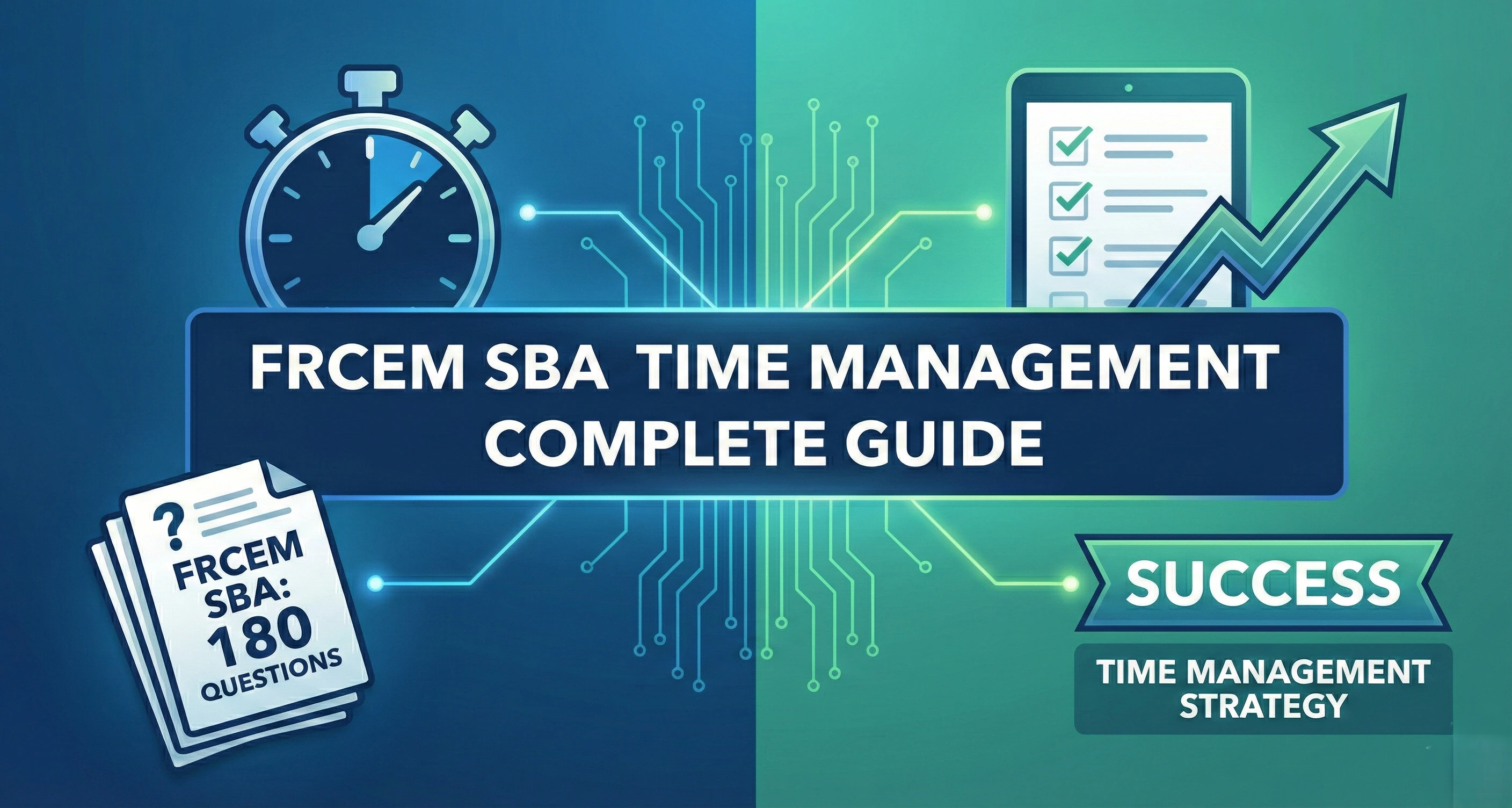

Sitting down for four hours to answer 180 FRCEM SBA questions feels overwhelming.
Your brain needs to process complex clinical scenarios, recall guidelines, eliminate distractors, and select the single best answer—all in roughly 80 seconds per question.
Time management isn't just helpful for the FRCEM—it's essential. Poor pacing is responsible for roughly 35% of exam failures. Candidates who run out of time leave easy marks unanswered, while those who rush make careless errors on questions they actually know.
In this guide, we will show you exactly how to pace yourself, manage uncertainty, and ensure you answer every question with time to spare.
Understanding the Time Challenge
The FRCEM SBA consists of two 90-question papers with two hours per paper. Simple math gives you 80 seconds per question. That sounds reasonable until you factor in reality.
What 80 seconds actually means:
Read a 4–6 line clinical vignette.
Understand what's being asked.
Consider five answer options.
Recall relevant guidelines.
Eliminate wrong answers.
Select the best option.
Move to the next question.
Try timing yourself on a single complex cardiology question. Many take 2–3 minutes when you're learning. The exam doesn't care. At 80 seconds average, you have zero buffer time.
This is why time management separates passing candidates from those who fail despite knowing the content. We previously discussed how hard the FRCEM exam is, and the time pressure is a huge factor in that difficulty.
The "Three-Pass" Strategy
The most effective approach isn't to answer Question 1 through 90 in order. It is to use three distinct passes through each paper. This maximizes marks while managing time pressure.
Pass 1: Confident Answers (Target: 75 minutes)
Your goal is to answer every question you're confident about without getting stuck on difficult ones.
Read the question first, not the vignette. Knowing what's being asked focuses your reading. If it asks about initial investigation, you scan for clinical features. If it asks about management, you focus on severity.
Set a strict internal limit. If you are uncertain after 60 seconds, flag it and move on immediately. No exceptions.
Trust your gut. If you immediately think "IV fluid resuscitation" and that's an option, select it. Don't second-guess yourself into wrong answers.
Checkpoint: By the end of this pass, you should have ~70 questions answered and ~20 flagged for review. You will have 40–45 minutes remaining.
Pass 2: The "Deep Dive" (Target: 35 minutes)
Return to your flagged questions with fresh eyes. Often, reviewing later helps you spot details you missed initially.
Re-read the question stem. Many questions are flagged because you misread what was asked. "Most appropriate next step" is different from "most likely diagnosis."
Use elimination aggressively. Even on difficult questions, you can usually eliminate 2 options as clearly wrong. Choosing between three options improves your odds significantly.
Look for guideline clues. If one option aligns with a specific NICE or RCEM guideline, it is often correct.
Pass 3: Final Review and Guesses (Target: 10 minutes)
Never leave blanks. There is no negative marking. A guess has a 20% chance of being correct; a blank has 0%.
Check for errors. Scroll through the entire paper to ensure no questions were accidentally skipped.
The 80-Second Mental Framework
Developing an automatic process for each question improves both speed and accuracy.
Seconds 0–10: Read the lead-in question (know what they want).
Seconds 10–35: Read the vignette (scan for keywords).
Seconds 35–60: Eliminate obviously wrong options.
Seconds 60–80: Select the best option and confirm.
If you are still stuck at the 80-second mark? Flag and move.
This framework becomes automatic with practice. If you are struggling to fit study into your schedule to practice this, check our guide on how to study for FRCEM while working full time for tips on efficient revision blocks.
Common Time Management Mistakes
1. Reading Every Word of Long Vignettes
FRCEM questions include deliberate "red herrings"—information irrelevant to the actual question.
The Fix: Read the question before the vignette. If it asks for an investigation, you don't need the detailed drug history.
2. Overthinking Straightforward Questions
When a question seems too easy, many candidates assume it's a trap.
The Fix: If you are confident and your answer aligns with guidelines, select it. FRCEM includes easy questions intentionally. For more on this, read our guide on Common FRCEM Mistakes That Cost You Marks.
3. The "Spiral of Doom"
Spending 4 minutes on one impossible Toxicology question puts you behind schedule, forcing you to rush 5 easy Paediatric questions later.
The Fix: Be ruthless. One hard mark is not worth sacrificing three easy marks.
Building Your Stamina
Time management improves with deliberate practice, not just experience.
Weeks 1–4: Practice untimed questions to focus on accuracy.
Weeks 5–12: Introduce the timer. Aim for 20–30 questions daily with strict 80-second limits.
Weeks 13–20: Full mock exams. You need to simulate the mental fatigue of a 2-hour paper.
Managing the One-Hour Break
The break between Paper 1 and Paper 2 is critical.
DO: Eat a light snack (banana, nuts), hydrate, and walk around.
DON'T: Discuss questions with other candidates. It only creates anxiety ("Did you put A or B for the sepsis question?").
The Goal: Reset your brain. Treat Paper 2 as a fresh start, regardless of how Paper 1 went.
Summary: How to Pass on Time
Use the Three-Pass Strategy: Don't let hard questions block easy ones.
Be Ruthless: If you don't know it in 90 seconds, flag it.
Trust Your Gut: First instincts are usually correct.
Practice Under Pressure: Use a timer during your revision.
Ready to Test Your Speed?
Theory is good, but practice is better. You need a question bank that mimics the real exam interface and time pressure.
At StudyFRCEM, our platform includes timed mock modes designed to help you master the 80-second rhythm before exam day.