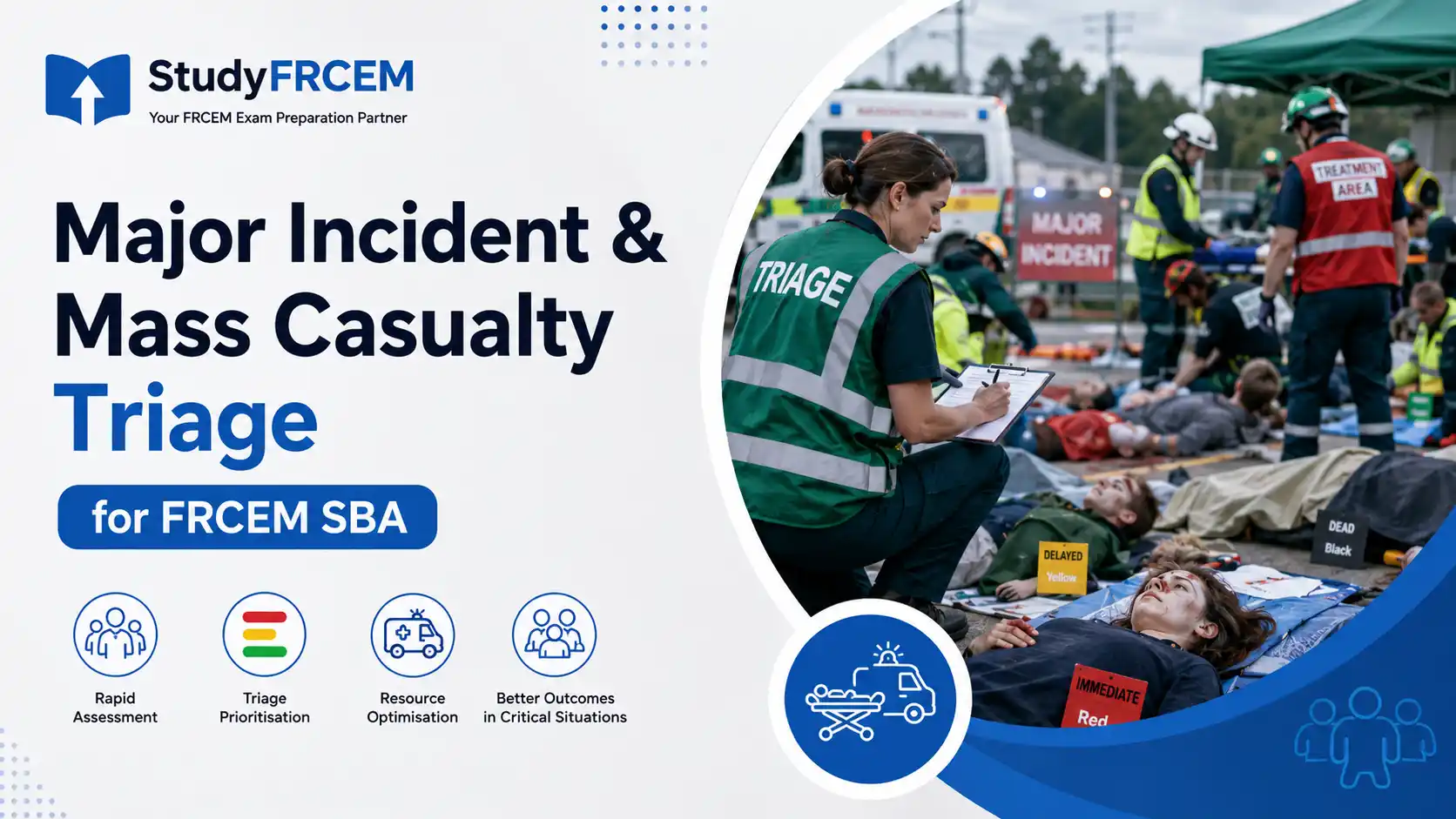

If you've spent any time revising for the FRCEM SBA, you've probably noticed that major incident triage keeps showing up — in past paper discussions, in RCEM Learning modules, in trainee forums. It's not a topic you can afford to guess your way through. Examiners like it because it tests a specific skill: can you make a rapid, structured decision under time pressure, using a system rather than instinct? That's exactly what a major incident throws at you in real life, and it's exactly what the exam is trying to simulate on paper.
This guide walks through what you actually need to know about major incident and mass casualty triage for the FRCEM SBA — the tools, the categories, the underlying logic, and, importantly, how this content tends to get turned into exam questions.
What Actually Counts as a Major Incident
Before you can triage correctly, you need to recognise when the "major incident" framework applies at all. The classic definition, drawn from the Major Incident Medical Management and Support (MIMMS) manual, centres on one idea: the situation involves a location, number, severity, or type of casualty that demands resources beyond what's normally available.
A few things worth locking in for exam purposes:
A major incident isn't defined purely by casualty numbers — a single patient with an unusual contamination risk can trigger a major incident response
"Mass casualty" situations specifically describe events where casualty numbers overwhelm even the extraordinary resources normally mobilised for a major incident
The trigger is about the mismatch between demand and available resources, not an absolute threshold
Examiners sometimes test this definition directly, but more often they embed it in a scenario and expect you to recognise the situation before you even get to the triage question.
Where This Sits in the RCEM Curriculum
Major incident management falls under the RCEM 2021 curriculum, and it's the kind of topic that gets tested precisely because most trainees haven't lived through a real major incident. You're expected to have participated in at least one major incident exercise during higher specialty training, and the curriculum treats this as core knowledge for a consultant-level emergency physician — not a niche add-on.
Because the FRCEM SBA blueprint allocates marks across the full breadth of the curriculum rather than concentrating on a handful of "greatest hits" topics, major incident triage tends to appear as a smaller but consistent slice of the 180 questions. It's rarely the single biggest topic on the paper, but it's reliably present, which makes it a poor topic to leave to chance.
From Sieve and Sort to Modern Triage Tools
For years, UK ambulance services relied on a triage approach known as Sieve and Sort. Over time, it became clear that this model had significant limitations — particularly in its ability to reliably identify the sickest patients. That gap led NHS England to develop two newer tools that you're now expected to know: Ten Second Triage and the NHS Major Incident Triage Tool.
Understanding why these tools replaced the older model matters for the exam, because examiners sometimes frame questions around the rationale for using a particular tool at a particular stage of the response, not just the mechanics of the tool itself.
Ten Second Triage (TST)
Ten Second Triage is designed to be used by any first responder — police, fire, ambulance staff — even before dedicated clinical teams arrive on scene. Its entire design philosophy is speed and simplicity.
The algorithm asks a handful of quick questions:
Is the patient walking?
Are they talking?
Are they breathing?
Is there a visible central penetrating injury?
These simple checks give a basic read on cardiovascular and airway status, which is enough to flag the highest-acuity patients immediately, without requiring clinical training to interpret. One detail that trips people up in questions: TST labels a patient as "not breathing" rather than "dead" when assessed by a non-clinician, because this keeps the door open for resuscitation efforts such as CPR once more resources arrive. Clinicians can also use TST for an initial sweep before switching to more detailed assessment.
NHS Major Incident Triage Tool (MITT)
Once enough clinical staff are on scene, the response shifts to a more detailed physiological assessment using the NHS Major Incident Triage Tool. MITT is built for accuracy and reproducibility — it's meant to catch high-acuity patients more reliably than earlier models, using physiological parameters rather than simple binary questions.
Key exam-relevant points:
MITT works for both adult and paediatric patients
Paediatric assessment includes an adjustment for rescue breaths
Children under two years old are automatically classified as the highest priority category, regardless of their physiological findings
That last point is a classic single-best-answer trap: a question might describe a young infant with seemingly stable observations, and the "obvious" answer might look like a lower priority category — but the automatic under-two rule overrides that.
The Five Triage Categories
Both TST and MITT ultimately sort patients into the same five categories:
Priority One (Immediate): needs life-saving intervention, treatment required within the hour
Priority Two (Urgent): unwell but relatively stable, treatment typically needed within two to four hours
Priority Three (Delayed): the "walking wounded" — able to mobilise to a treatment area, safe to delay treatment beyond four hours
Dead: assessed by a clinician and confirmed not breathing
Not Breathing: assessed by a non-clinician and found not breathing, without formal death confirmation
Exam questions often hinge on distinguishing Priority One from Priority Two — the difference usually comes down to a specific physiological marker (respiratory rate, capillary refill, mental status) rather than the general "sickness" of the vignette description. Read the numbers carefully rather than relying on gut feeling about how unwell the patient sounds.
What Actually Counts as a Life-Saving Intervention
Here's a subtlety that's easy to miss but genuinely useful for the exam: what actually qualifies as a "life-saving intervention" for defining a Priority One patient has historically been vague. A well-known Delphi consensus study brought together UK and South African emergency care and major incident management experts to systematically work through dozens of candidate interventions and establish which ones experts agree genuinely qualify as life-saving in the definitive care phase of a major incident.
Why this matters for revision: it tells you that "life-saving intervention" isn't just a phrase to memorise — it's a defined, consensus-based category, and the SBA can test your understanding of which interventions actually meet that threshold versus which ones are supportive or delayed care. If a question lists an intervention and asks whether it justifies Priority One classification, think in terms of immediacy and survival impact, not just clinical importance.
How FRCEM SBA Actually Tests This Topic
Understanding the tools is only half the job — knowing how examiners turn them into questions is what actually earns marks.
Common patterns to watch for:
Scenario-based triage category questions — a short vignette with specific vital signs, and you're asked to assign the correct category. The distractors are usually one category too high or too low, testing whether you know the exact cut-offs.
"Which tool would you use" questions — testing whether you know TST is for early, non-clinician-led response and MITT is for the clinical phase once resources are established.
Paediatric exception questions — testing the under-two automatic Priority One rule specifically, because it's a rule candidates often forget under time pressure.
Definition-based questions — testing your recall of what constitutes a major incident versus a mass casualty incident.
Systems and process questions — testing your knowledge of how triage should be performed (in pairs, systematically, with ongoing tallying and tagging) rather than pure clinical categorisation.
Practical Triage Principles Worth Knowing
A few operational details show up in questions more often than people expect:
Triage is ideally performed as a pair — one clinician assesses, the other records and cross-checks against the tool
Patients should be assessed systematically and one at a time, so no one gets missed
The preliminary assessment is meant to be fast — ideally around ten seconds per patient
Treatment during initial triage is deliberately limited to catastrophic haemorrhage control, opening an airway, or placing a patient in the recovery position
Every triaged patient needs a visible marker of their category — a wristband, tag, or similar — so subsequent teams don't have to re-triage from scratch
Common Mistakes Candidates Make
Confusing TST (non-clinician, preliminary) with MITT (clinician-led, definitive)
Forgetting the paediatric under-two automatic Priority One rule
Assuming "Dead" and "Not Breathing" are interchangeable categories — they're distinguished specifically by who performed the assessment
Over-treating during the initial triage pass, rather than sticking to the three permitted interventions
Misjudging Priority One vs. Priority Two based on general clinical impression rather than the specific physiological criteria in the vignette
How to Revise This Topic Efficiently
Because major incident triage is a defined, rule-based topic rather than an open-ended clinical judgement area, it rewards focused revision far more than broad reading. Rather than working through long narrative articles, it's more efficient to drill scenario-based single-best-answer questions that force you to apply the TST and MITT criteria repeatedly until the category cut-offs become automatic. This is exactly the kind of high-yield, rule-based topic that benefits from RCEM-aligned SBA practice questions with detailed explanations — so you're not just memorising a flowchart, but seeing how examiners phrase the traps around it.
Conclusion
Major incident triage rewards structured knowledge over clinical intuition — which is exactly why it suits the SBA format so well, and exactly why it's worth revising properly rather than skimming. Once you've internalised the TST and MITT criteria, the five categories, and the specific exceptions examiners like to test, this becomes one of the more predictable topics on the paper rather than one you're hoping to talk your way through.
If you want to test how well this has actually stuck, StudyFRCEM's question bank includes SLO-mapped major incident and mass casualty scenarios with consultant-written explanations, so you can see exactly where the exam's traps tend to sit before you meet them in the real thing. Try a free demo to see how the questions are structured.
Frequently Asked Questions
What's the difference between Ten Second Triage and the NHS Major Incident Triage Tool?
TST is a rapid, non-clinician-friendly tool used at the very start of a response, before clinical teams arrive. MITT is a more detailed, physiology-based tool used by clinicians once sufficient resources are on scene.
Are children automatically triaged differently under MITT?
Yes. MITT includes an adjustment for rescue breaths in paediatric patients, and any child under two years old is automatically classified as Priority One regardless of their observations.
What treatments are allowed during the initial triage pass?
Only catastrophic haemorrhage control, opening the airway, and placing the patient in the recovery position — anything beyond that is deferred to the definitive treatment phase.
Why does TST use "not breathing" instead of "dead" as a category?
Because TST can be performed by non-clinicians, "not breathing" keeps resuscitation options open, whereas "dead" is only confirmed once a clinician has formally assessed the patient.
How heavily is major incident triage weighted in the FRCEM SBA?
It's not one of the largest single topics on the paper, but it appears consistently across sittings, making it a reliable, learnable source of marks rather than an unpredictable one.