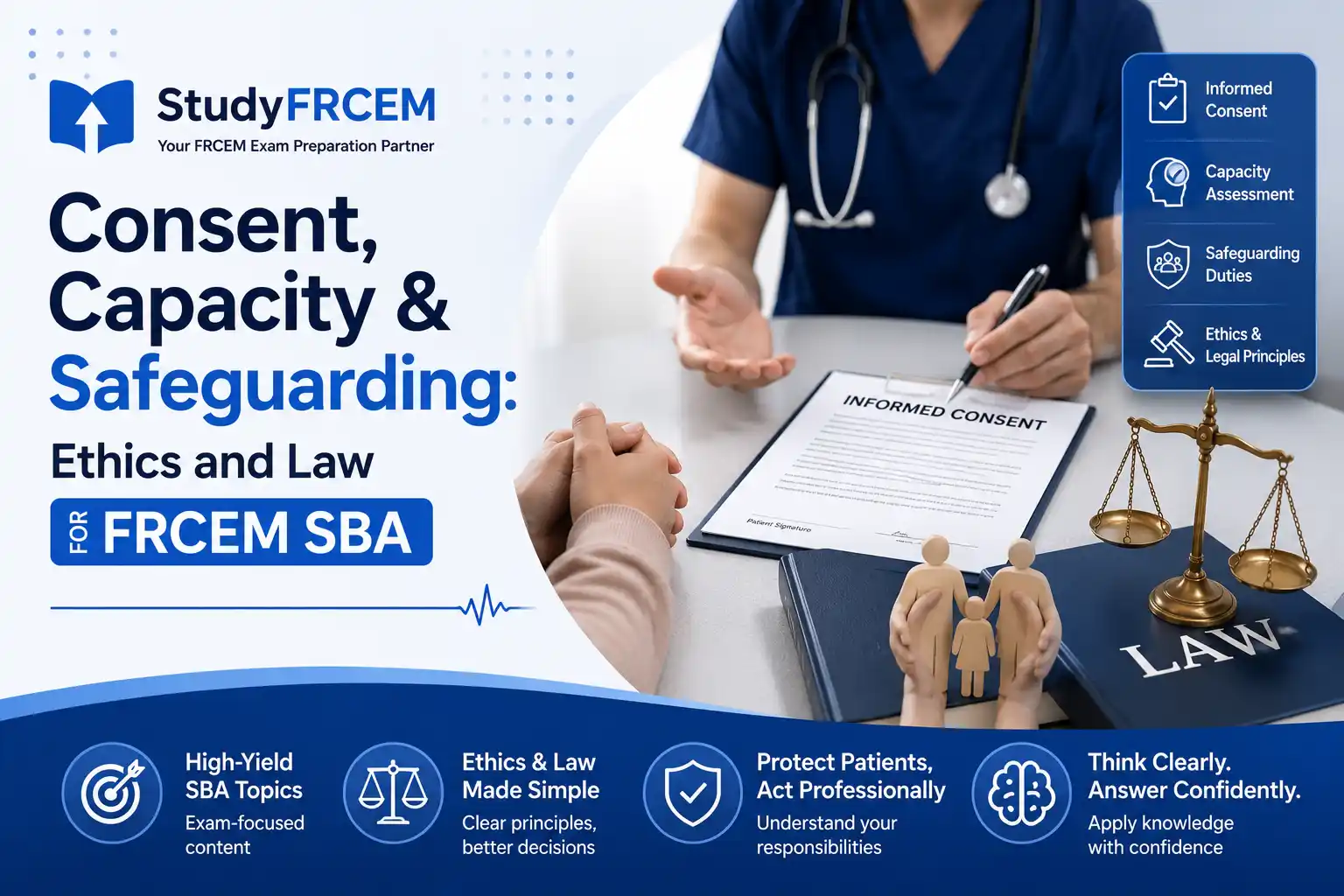

For many FRCEM candidates, clinical medicine feels manageable—it's the ethics and law questions under SLO7 that quietly cost marks. Consent, capacity, and safeguarding scenarios are deceptively simple on the surface, but the FRCEM SBA is built to test whether you can apply the correct legal framework under pressure, not just recall a definition. Get the framework wrong, and even a clinically sound answer becomes the wrong one.
This guide breaks down exactly what you need to know about consent, capacity, and safeguarding for the FRCEM SBA — the legal principles, how examiners twist them into single-best-answer traps, and how to walk into these questions with a clear decision-making structure instead of guesswork.
Why Consent & Capacity Matter So Much in the FRCEM SBA
Confidentiality, end-of-life decisions and parental responsibility are also part of SLO7 ‘Complex or Challenging Situations,' which includes consent, capacity and safeguarding. This is not a 'special' aspect of the curriculum. This is a common and frequent issue, and that's why it is a recurring one and it is a hot one, because Emergency Medicine has to make these decisions every day and often without having enough information and without having the time to consult the textbook.
This is a popular topic with examiners, where they are testing judgement, not just knowledge. A question could be a confused elderly patient who is resisting a life-saving intervention, a teenager asking his or her parents to keep their treatment confidential, and an intoxicated patient who refuses treatment. Each scenario has a legally correct answer — and usually three or four tempting wrong ones designed to catch candidates who rely on instinct rather than the actual legal test.
Understanding the frameworks properly doesn't just help you pass—it reflects exactly the kind of decision-making you'll be expected to demonstrate as a working EM consultant.
The Mental Capacity Act 2005: The Core Framework
Almost every capacity question in the FRCEM SBA traces back to the Mental Capacity Act (MCA) 2005. If you remember one structure from this article, make it this one.
Presumption of capacity. Every adult is presumed to have capacity unless it is established otherwise. The exam will often present a patient behaving oddly or refusing sensible treatment — this alone does not mean they lack capacity.
The two-stage test. Capacity assessment under the MCA has two distinct stages:
Stage 1 (diagnostic test): Is there an impairment or disturbance in the functioning of the mind or brain? This could be due to intoxication, dementia, delirium, mental illness, or a head injury.
Stage 2 (functional test): Does that impairment mean the person cannot make this specific decision, at this specific time?
Both stages must be satisfied. An impairment alone (Stage 1) is not enough — the person must also fail the functional test (Stage 2) for capacity to be lacking.
The four-part functional test. To have the capacity to make a decision, a person must be able to:
Understand the information relevant to the decision
Retain that information long enough to make the decision
Weigh that information as part of the decision-making process
Communicate their decision by any means
Failure on any single one of these four elements is sufficient to establish a lack of capacity for that specific decision.
Assessing Capacity in the ED — Practical Application
The exam rarely tests the MCA in the abstract. It tests your ability to apply it to messy, real-world ED scenarios.
Capacity is decision-specific and time-specific. A patient may have capacity to consent to a wound closure but lack capacity to make a complex decision about surgical intervention. Capacity can also fluctuate — an intoxicated patient may regain capacity once sober, and reassessment at that point is the correct approach rather than assuming permanent incapacity.
Unwise decisions are not the same as incapacity. This is one of the most heavily tested distinctions in the FRCEM SBA. A patient with full capacity is entitled to refuse treatment, even if that decision seems irrational or dangerous to the clinician — as long as they pass the four-part functional test. The exam will present a patient making a decision that seems clinically unwise, and the correct answer is often to respect that decision, not override it.
Implied consent covers routine procedures. Venepuncture, physical examination, ECG recording, and small wound closure can often be justified through implied consent — demonstrated by the patient's cooperation with the procedure — without requiring a formal, explicit consent discussion each time.
When Treatment Can Proceed Without Consent
Certain situations permit treatment to proceed even without the patient's consent, and the SBA tests these boundaries precisely.
Emergency, life-saving treatment: Treatment may be given without consent if it is immediately necessary to save life or prevent serious deterioration, and the patient lacks capacity to consent at that moment.
Best interests principle: When a patient lacks capacity, any decision made on their behalf must be in their best interests, taking into account their known wishes, beliefs, and values wherever possible — not simply what the clinician judges to be medically optimal in isolation.
All practical steps first: Before concluding a patient lacks capacity, all practical and appropriate steps should be taken to support their decision-making — simplifying information, treating pain, allowing time, or reducing intoxication where feasible.
Mental Health Act vs Mental Capacity Act—The Distinction Examiners Love to Test
This is one of the most commonly confused areas in FRCEM SBA ethics questions, and examiners know it.
The Mental Capacity Act (MCA) applies to all physical and mental health care decisions relating to a person's ability to give informed consent.
The Mental Health Act (MHA) permits detention and treatment for a mental disorder, whether or not the patient can give consent, but treatment of unrelated physical health issues is not automatically covered.
If a patient is detained under the MHA because of mental illness, they are treated for this mental disorder, and in some circumstances, for physical health issues that are directly connected to the mental disorder. However, unrelated physical conditions still require a separate capacity assessment under the MCA.
Restriction vs deprivation of liberty is another frequently tested nuance. Short-term restraint used in the ED to manage an acutely disturbed or confused patient is generally considered a restriction, not a deprivation of liberty — meaning formal DOLS (Deprivation of Liberty Safeguards) paperwork is usually not required for brief ED management, though this should always be time-limited, proportionate, and clearly documented.
Consent & Capacity in Children
Paediatric consent questions follow a different legal structure, and mixing up the adult and paediatric frameworks is a common cause of lost marks.
Gillick competence determines whether a child under 16 has the maturity and understanding to consent to their own treatment without parental involvement.
Fraser guidelines apply specifically in the context of contraceptive and sexual health advice for under-16s.
16 to 17-year-olds are presumed to have capacity to consent to treatment in their own right, similar to adults, though parents may also provide consent on their behalf under the Children Act in most circumstances.
Parental responsibility becomes especially relevant when a competent child refuses treatment that parents wish to consent to — a legally complex area where complex or contested cases may require discussion with a senior clinician or trust legal team rather than a unilateral ED decision.
Safeguarding Essentials for the FRCEM SBA
Safeguarding questions often sit alongside consent and capacity scenarios, testing whether you recognise red flags and know your duty to escalate.
Recognise inconsistent histories, delayed presentation, or injury patterns that don't match the explanation given, in both adult and child safeguarding contexts.
Escalation is not optional. If safeguarding concerns arise, the correct SBA answer almost always involves informing the relevant safeguarding lead or team, not managing the concern alone.
Document everything carefully, particularly when a patient refuses to discuss a concerning history — this protects both the patient and the clinician, and is frequently the detail an SBA question is quietly testing.
Capacity does not override safeguarding duty. Even a patient with full capacity who declines to disclose information may still trigger a safeguarding referral if risk to a third party (such as a child) is identified.
Common SBA Traps & Exam Technique
Knowing the legal theory is only half the battle—the FRCEM SBA is designed to test whether you can apply it under exam pressure. Watch for these recurring traps:
Questions that present an unwise decision and expect you to override it—usually the wrong answer if the patient has capacity
Scenarios blending MHA and MCA principles, expecting you to identify which applies to the specific treatment in question
Paediatric scenarios that test Gillick competence against parental refusal or consent
Questions describing brief restraint in the ED, testing whether you correctly identify it as a restriction rather than a deprivation of liberty
Distractor options that sound ethically appropriate but skip a required legal step, such as failing to document a capacity assessment before proceeding
The strongest exam technique is to identify the legal framework being tested first—MCA, MHA, or the Children Act—before evaluating the clinical scenario itself. This single habit resolves the majority of consent and capacity SBA questions correctly.
Conclusion
Consent, capacity, and safeguarding questions reward candidates who think in frameworks rather than instinct. Once you can reliably separate MCA from MHA, understand the four-part functional test, and recognize the paediatric consent structure, these questions shift from a weak spot to a reliable source of marks.
The best way to consolidate this is through realistic, exam-style practice. StudyFRCEM's question bank includes SLO7 ethics and law scenarios written by NHS Emergency Medicine consultants, with detailed explanations that walk through exactly why each option is right or wrong—not just the correct answer.
Frequently Asked Questions
Does the FRCEM SBA test the Mental Capacity Act in detail?
Yes, the MCA 2005 is a core part of SLO7 and appears frequently in scenario-based questions. Candidates are expected to apply the two-stage and four-part tests, not just recall definitions.
Can a patient with capacity refuse life-saving treatment?
Yes, a patient with full capacity is legally entitled to refuse treatment, even if the decision appears unwise. The exam frequently tests whether candidates respect this right correctly.
What's the difference between Gillick competence and the 16–17 age rule?
Gillick competence assesses whether a child under 16 has sufficient maturity to consent independently, while 16–17-year-olds are presumed to have capacity similarly to adults under separate legal provisions.
Do I need DOLS paperwork for short-term restraint in the ED?
Generally, no—brief, proportionate restraint used to manage an acutely disturbed patient is usually classed as restriction rather than deprivation of liberty, though this should be reassessed if prolonged.
How should I approach safeguarding questions in the SBA?
Identify red flags, prioritize escalation to the appropriate safeguarding lead, and remember that documentation and duty to escalate typically outweigh managing the concern independently.