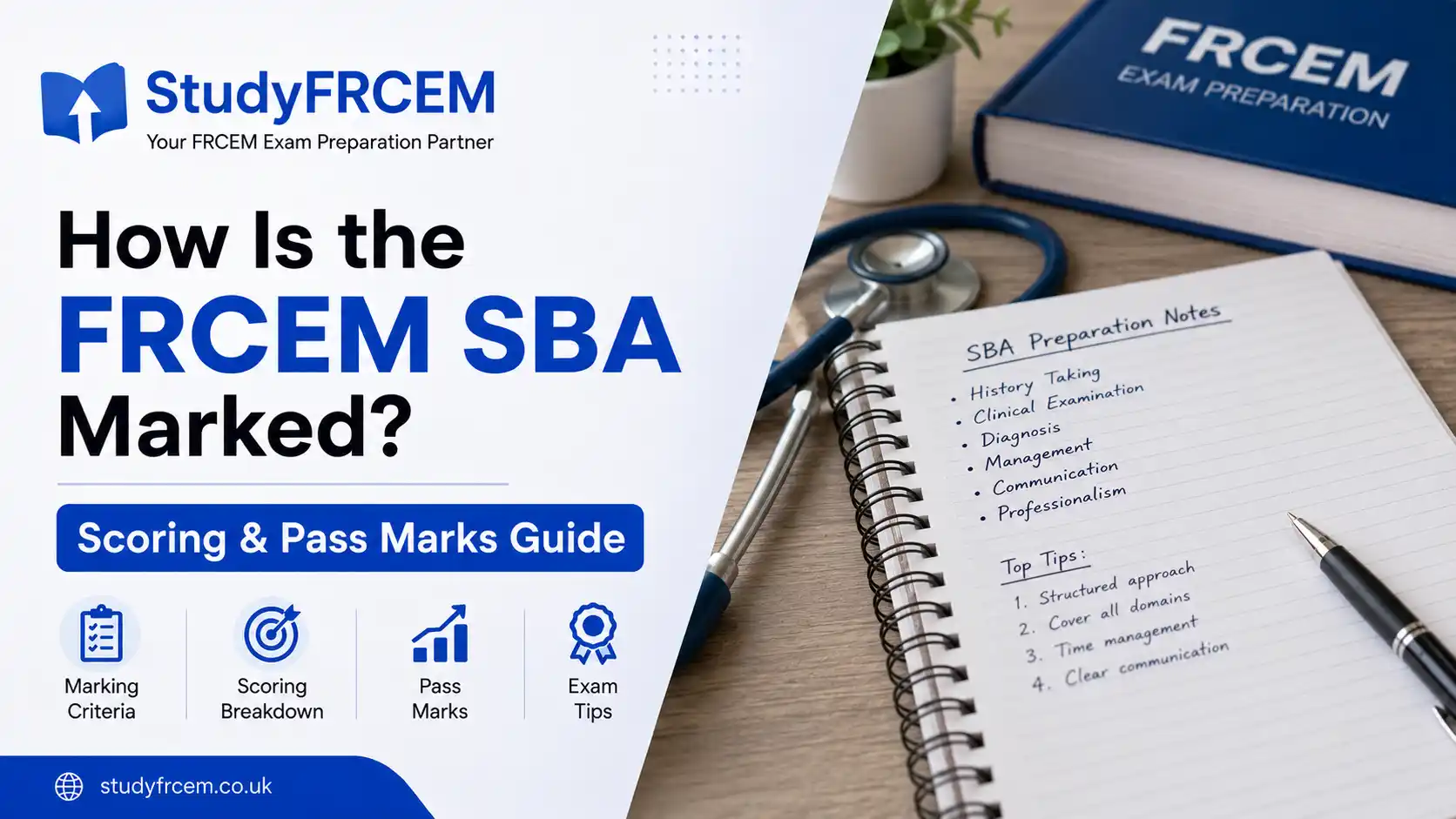

If you're preparing for the FRCEM SBA, you've probably noticed something strange: nobody can tell you the exact pass mark before you sit the exam. That's not an oversight — it's by design. Understanding how the FRCEM SBA is marked takes away a lot of the guesswork and anxiety around "what score do I actually need," and it changes how you should be revising.
This guide breaks down exactly how RCEM marks the FRCEM SBA, what the Angoff method is, why the pass mark moves every sitting, and what all of this means for your revision strategy.
A Quick Recap: FRCEM SBA Exam Format
Before getting into marking, it helps to know what you're actually seeing:
180 Single Best Answer (SBA) questions
Split into two papers of 90 questions each
Two hours per paper, with a one-hour break in between
Delivered via Surpass Assessment at test centres worldwide
Blueprinted against the full RCEM 2021 Emergency Medicine curriculum, including research, QI, and education (SLOs 10–12)
Every question gives you a clinical stem with several options. More than one option may look plausible — but only one is genuinely the single best answer. This is where marking becomes important, because it's not about ticking "correct vs incorrect" in isolation — it's about how those correct answers translate into a pass or fail.
How Is the FRCEM SBA Marked?
The mechanics of scoring are actually simple:
The exam is machine marked — there's no human scoring individual scripts
A correct answer scores one mark
An incorrect answer scores zero
There is no negative marking
That last point matters more than people realise. Since wrong answers don't cost you anything, there is no strategic reason to leave a question blank. If you're unsure, eliminate the options you know are wrong and make an educated guess — an unanswered question and a wrong guess score identically, so guessing can only help you.
So on the surface, marking looks like basic multiple-choice scoring. The complexity — and the part most candidates don't fully understand — is in how RCEM decides what score you actually need to pass.
What Is the Angoff Method?
The FRCEM SBA doesn't use a fixed pass mark like "you need 70% to pass." Instead, RCEM uses a recognised standard-setting process called the modified Angoff method, which is approved by the GMC and the Academy of Medical Royal Colleges.
Here's how it works, according to RCEM's own published explanation:
A panel of subject matter experts (SMEs) — practising EM consultants who are also involved in training and question writing — reviews every single question on the paper
For each question, each SME estimates what proportion of a "minimally competent candidate" group would answer it correctly
Judges then discuss any differences in their ratings and can revise their scores after that discussion
Each item's ratings are averaged to produce an Angoff score for that question
All the individual Angoff scores are added together to create the total Angoff score for the exam
In other words, the pass mark isn't decided by looking at how candidates actually perform — it's decided in advance by expert judgement of how difficult each question is. This is what's known as criterion-referenced assessment: you're being measured against a fixed standard of competence, not ranked against other candidates.
Why the FRCEM SBA Pass Mark Isn't Fixed Every Sitting
This is usually the part that confuses candidates most. If the Angoff method sets the pass mark, why does it change every diet?
The answer comes down to two things:
Different question combinations. Every sitting uses a different set of 180 questions, and no two questions are judged as equally difficult. If a diet happens to include more challenging items, the total Angoff score — and therefore the pass mark — will be lower. An easier paper produces a higher pass mark.
Standard Error of Measurement (SEM). For the FRCEM SBA, one SEM is added on top of the Angoff score to calculate the final pass mark. SEM reflects the measurement error specific to that cohort of candidates, and it varies from diet to diet too.
Because both the Angoff score and the SEM shift between sittings, the final pass mark is never fixed and is not published in advance. For example, the pass mark for the October 2024 FRCEM SBA was 108 out of 180. That number won't necessarily apply to your sitting — it depends entirely on the difficulty profile of your specific paper.
This is exactly why chasing a "target score" from a forum post is unreliable. The only genuinely useful strategy is preparing to answer as many questions correctly as possible, regardless of what the eventual cut score turns out to be.
What Happens If Questions Get Removed After the Exam?
Here's a detail most candidates never hear about until it happens to them.
After every sitting, RCEM runs a quality assurance review. This looks at how real candidates responded to each item, which can flag problems that weren't obvious before the exam — things like:
Ambiguous or confusing wording
Faulty or unclear images
Answer options that turned out to be flawed
If an item is found to be unfair, it's removed from the exam entirely. When that happens:
The item's marks are removed from the total achievable score (e.g., 180 becomes 177 if 3 items are pulled)
The item's original Angoff score is also removed from the total Angoff score
The raw pass mark adjusts downward accordingly
Importantly, RCEM has stated that item removal does not disadvantage candidates — if anything, it tends to make passing slightly easier, since the proportion of candidates who pass typically increases once flawed items are stripped out.
How Difficult Is the FRCEM SBA, Really?
The Angoff process exists because this is a genuinely tough exam. RCEM's own statistics put the 2023 pass rate at around 47% — meaning over half of candidates who sit the FRCEM SBA do not pass on that attempt. This isn't unusual for a consultant-level exit exam, but it does underline why understanding the marking system matters: you're not aiming for an arbitrary percentage, you're aiming to demonstrate consultant-level competence across the entire curriculum.
A few practical implications of this:
Since marking is criterion-based, other candidates' performance doesn't affect your result — you're not competing against a curve
Because the pass mark moves with question difficulty, a "hard" sitting isn't automatically bad news for you personally, since the bar moves too
Since there's no negative marking, time management and answering every question matters more than being overly cautious
Results and Feedback
Once marking and adjudication are complete, results are released to your RCEM account, typically five to six weeks after the exam date, with an email notification once available. Alongside your pass/fail outcome, RCEM issues a feedback letter breaking down your performance by curriculum area or Specialty Learning Outcome (SLO), which is genuinely worth reviewing closely — even after a pass — to identify weaker domains before your OSCE prep.
What This Means for Your Revision Strategy
Once you understand that the FRCEM SBA pass mark is a moving target based on question difficulty — not a fixed percentage — the smartest preparation approach becomes clear:
Focus on breadth across the full 2021 curriculum, including the commonly neglected SLOs like research, QI, and education, since every mark still counts toward the total
Practise under timed conditions so pacing across 90 questions in two hours becomes automatic
Prioritise understanding why wrong options are wrong, not just recognising the right one — this mirrors exactly how Angoff judges assess "minimally competent" performance on each item
Review detailed, guideline-referenced explanations (NICE, RCEM, Resus Council UK) rather than memorising isolated facts, since SBA questions are designed to test applied clinical reasoning
Don't fixate on hitting a specific historical pass mark like 108/180 — treat it as context, not a target, since your own sitting's cut score will be different
This is exactly the gap a structured, consultant-written FRCEM SBA question bank is built to close — working through topic-based questions with detailed rationale for every option helps you build the kind of item-level accuracy that the Angoff panel is effectively testing for.
Conclusion
At the end of the day, the FRCEM SBA isn't marked against a fixed number — it's marked against a standard of consultant-level competence, judged question by question through the Angoff method. Once you stop chasing a "magic pass mark" and focus on genuinely understanding the curriculum, guidelines, and reasoning behind each answer, the marking system starts working in your favour rather than feeling like a mystery.
Frequently Asked Questions
Is the FRCEM SBA marked by a computer or a person?
It's fully machine-marked. Every correct answer earns one mark, and there's no human scoring involved.
Is there negative marking on the FRCEM SBA?
No. Incorrect and unanswered questions both score zero, so you should attempt every question.
Why does the FRCEM SBA pass mark change each sitting?
The pass mark depends on the Angoff-rated difficulty of that specific paper plus the standard error of measurement, both of which vary between diets.
What was a recent FRCEM SBA pass mark?
The October 2024 sitting had a pass mark of 108 out of 180, though this figure only applies to that specific diet.
Can removing a flawed exam question hurt my score?
No. RCEM has confirmed that item removal doesn't disadvantage candidates and usually slightly improves pass rates.