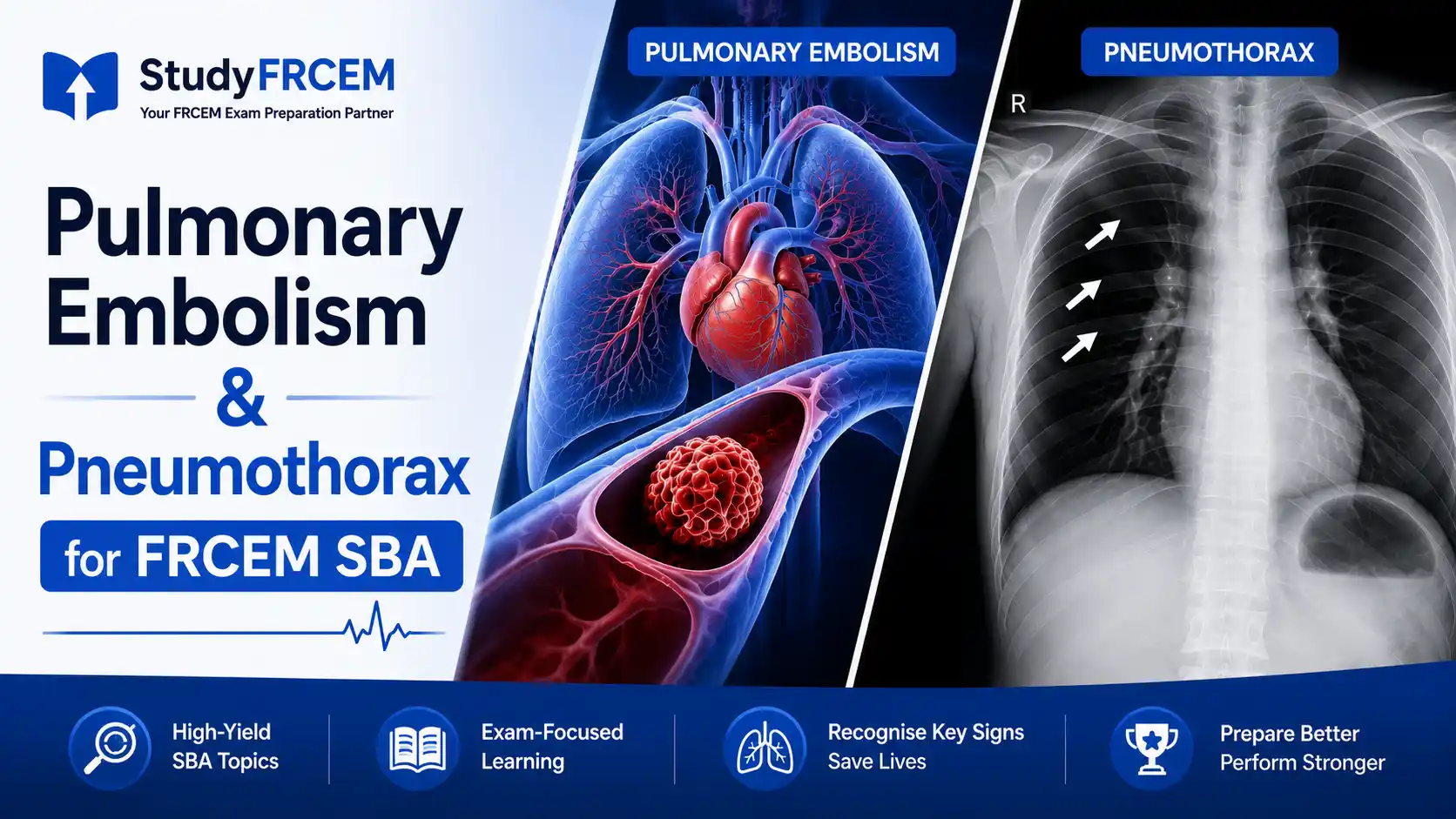

If you've started mapping out your FRCEM SBA revision, you've probably already noticed that respiratory emergencies punch well above their weight. Pulmonary embolism (PE) and pneumothorax show up again and again across SLO 2 and SLO 3, and examiners have a habit of testing the exact decision points where trainees hesitate — not just "do you know what PE is," but "do you know what the current guideline says to do about it."
That distinction matters more than most candidates realise. The FRCEM SBA doesn't reward textbook knowledge from five years ago. It rewards candidates who know what BTS, NICE, and RCEM say right now. And on both PE and pneumothorax, the guidance has shifted enough in recent years that older revision notes can actively work against you.
This guide walks through both topics the way they actually appear in the exam — scoring tools, investigation pathways, management decisions, and the specific traps that catch trainees out.
Why PE and Pneumothorax Are High-Yield FRCEM SBA Topics
Both conditions sit squarely inside the "physiologically unstable patient" and "breathless patient" presentations that the RCEM curriculum expects every FRCEM candidate to manage confidently. They're tested heavily because they combine three things examiners love:
A clear decision algorithm (which means there's a definitely "correct" SBA answer)
Recent guideline changes (which separate candidates with current knowledge from those without)
Life-threatening potential if mismanaged (which reflects real clinical stakes)
If you only revise one respiratory pairing properly before your exam, this is a strong candidate for it.
Pulmonary Embolism: What the SBA Actually Tests
Wells Score and the PERC Rule
Most PE-related SBA stems are testing whether you can correctly apply a risk-stratification tool to a described scenario, not whether you can recite it from memory.
Wells score is used in patients where PE is clinically suspected. It splits patients into "PE likely" and "PE unlikely" categories, which then determines your next investigation step.
PERC (Pulmonary Embolism Rule-out Criteria) is reserved for low pre-test probability patients. If a patient meets all PERC criteria, PE can reasonably be excluded without further testing, and no D-dimer is needed.
Trap to avoid: A common wrong answer is ordering a D-dimer in a genuinely low-risk patient who meets PERC criteria. If PERC clears the patient, ordering more tests isn't the safe option — it's the wrong one, because it increases false positives and unnecessary CTPA exposure.
Risk Stratification Beyond Wells
Once PE is confirmed or highly likely, the exam often shifts to a second decision: how sick is this patient, and where should they be managed?
Look for haemodynamic instability (hypotension, signs of shock) — this changes the entire management pathway
Tools like the PESI or simplified PESI score are used to identify patients who may be safely managed as outpatients versus those needing admission
SBA stems will often bury the haemodynamic status in a throwaway line of the vignette — a low blood pressure or high respiratory rate isn't incidental, it's the answer
PE Investigation Pathway: Where Candidates Lose Marks
The investigation sequence for suspected PE is one of the most heavily tested algorithms in emergency medicine, and it's also one of the easiest to get wrong under exam pressure.
PE unlikely (Wells) + doesn't meet PERC: D-dimer first. Negative D-dimer excludes PE; positive result proceeds to CTPA.
PE likely (Wells): Go straight to CTPA. Don't waste a step on D-dimer — a negative D-dimer in a high pre-test probability patient does not reliably exclude PE.
Renal impairment or contrast allergy: V/Q scan becomes the alternative to CTPA.
Pregnancy: Investigation pathway changes — this is a frequently tested subgroup, and candidates should know the modified approach rather than defaulting to the standard adult pathway.
Trap to avoid: Age-adjusted D-dimer thresholds are increasingly referenced in current guidance, particularly in older patients, where a standard cut-off produces more false positives. If an SBA stem specifies an older patient with a borderline D-dimer, the examiners may be testing whether you know the age-adjusted interpretation rather than applying a flat threshold.
PE Management: The Decisions the Exam Cares About
Anticoagulation Choice
Direct oral anticoagulants (DOACs) are now first-line for most confirmed PE cases in current UK guidance, replacing the older default of LMWH bridging to warfarin. LMWH still has a defined role in specific groups—notably:
Significant renal impairment
Antiphospholipid syndrome
Pregnancy
Active malignancy in some guidance pathways, depending on the specific DOAC and clinical picture
Trap to avoid: Defaulting to warfarin or LMWH-to-warfarin bridging as the "standard" answer is exactly the kind of outdated reasoning the SBA is designed to catch. If the stem doesn't flag a contraindication, DOAC is almost always the expected answer.
Thrombolysis in Massive PE
This is where haemodynamic instability from earlier in your assessment becomes decisive. Thrombolysis is indicated in confirmed PE with haemodynamic compromise (persistent hypotension or shock)—not simply in patients who "look unwell" or have a large clot burden on imaging without circulatory compromise.
Trap to avoid: Candidates sometimes select thrombolysis based on imaging severity alone. The exam is testing physiological criteria, not radiological ones. A large PE in a haemodynamically stable patient does not meet thrombolysis criteria.
Pneumothorax: The BTS 2023 Guideline Shift
This is arguably the single most important update for anyone sitting the FRCEM SBA in the current curriculum cycle. The 2023 BTS pleural disease guideline moved away from the older size-based cutoffs and introduced a more symptom-led approach to primary spontaneous pneumothorax.
Primary Spontaneous Pneumothorax
Rather than simply measuring pneumothorax size on the chest X-ray and applying a fixed rule, current guidance places much more weight on:
Degree of breathlessness
Patient preference and shared decision-making
Whether conservative management (observation) is appropriate even in larger pneumothoraces, provided the patient is not significantly symptomatic
Trap to avoid: If your revision notes still frame management purely around "less than 2cm = observe, more than 2cm = intervene," that's the older BTS 2010 approach. The SBA is written against current guidance, and an answer built on the old size-only rule is likely to be the deliberately wrong option in the answer set.
Secondary Spontaneous Pneumothorax
Secondary pneumothorax (occurring in patients with underlying lung disease, typically over 50 years old) is managed more cautiously than primary pneumothorax, with a lower threshold for intervention because these patients tolerate physiological compromise far less well.
Breathlessness and underlying respiratory reserve matter more than absolute size
Admission is generally required even for smaller pneumothoraces in this group
Tension Pneumothorax: The Emergency Scenario
Tension pneumothorax stems are written to test recognition speed and immediate management—this is a clinical diagnosis, and the exam knows it.
Recognition points the stem may embed:
Tracheal deviation
Absent breath sounds unilaterally with hyper-resonance
Hypotension with distended neck veins
Rapid deterioration, often post-trauma or in a ventilated patient
Management sequence commonly tested:
Immediate needle decompression as a temporizing measure, followed promptly by finger thoracostomy or chest drain insertion — do not wait for imaging confirmation in a genuinely unstable patient
Chest drain placement within the "triangle of safety" (bordered by the anterior border of latissimus dorsi, the lateral border of pectoralis major, and a line superior to the horizontal level of the nipple)
Trap to avoid: Ordering a chest X-ray before acting in a patient with a classic tension pneumothorax presentation. If the vignette gives you the clinical picture, imaging is a distractor answer, not the correct next step.
How These Topics Show Up as SBA Stems
Typical stems don't hand you the diagnosis outright—they give you a scenario and expect you to apply the pathway. A stem might describe a breathless patient with a recent long-haul flight and a specific heart rate and blood pressure and ask what your next step is—not what the diagnosis is. Getting comfortable extracting the relevant clinical variables (respiratory rate, blood pressure, oxygen saturation, and risk factors) from a wordy vignette is a skill in itself, separate from knowing the guideline.
This is exactly where structured question-bank practice earns its place in your revision—not just reading guidelines, but repeatedly applying them under the same conditions the exam uses.
Practicing These Pathways With StudyFRCEM
StudyFRCEM's respiratory question bank is built specifically around this kind of exam-style application—covering pneumothorax, PE, and respiratory failure with BTS-guideline-aligned questions and explanations written by NHS Emergency Medicine consultants. Each question includes a detailed explanation covering not just the correct answer, but why the distractors are wrong, which is exactly the reasoning skill the FRCEM SBA is testing.
If you want to see how these scenarios are structured before committing to a plan, the free demo gives you a direct feel for the question style.
Conclusion
PE and pneumothorax are two of the clearest examples of why "knowing emergency medicine" and "being exam-ready for FRCEM SBA" aren't quite the same thing. The clinical concepts haven't changed dramatically—but the guidelines behind them have, and that's precisely where the exam draws its distractor answers from.
If you want to test how confidently you can apply these pathways under exam-style conditions, try a free demo on StudyFRCEM and see where your respiratory revision actually stands before exam day.
Frequently Asked Questions
Is the Wells score or PERC rule more heavily tested in FRCEM SBA?
Both appear regularly, but they're tested in different contexts. Wells score stratifies suspected PE cases, while PERC is used specifically to safely rule out PE in low-risk patients without further testing.
Has the pneumothorax management guideline really changed for the FRCEM SBA?
Yes — BTS updated its 2023 pleural disease guideline to prioritise symptoms and shared decision-making over strict size cutoffs for primary spontaneous pneumothorax, replacing the older 2010 approach.
Should DOACs or LMWH be first-line for confirmed PE in the exam?
DOACs are first-line in the current UK guidance for most patients. LMWH is reserved for specific groups such as pregnancy, severe renal impairment, or antiphospholipid syndrome.
What's the immediate management of tension pneumothorax in an SBA stem?
Needle decompression is followed promptly by finger thoracostomy or chest drain insertion, based on clinical diagnosis alone—imaging should not delay treatment in an unstable patient.
Why do outdated PE and pneumothorax notes cause exam errors?
Because the FRCEM SBA is blueprinted against current RCEM, NICE, and BTS guidance. Answers based on older thresholds or algorithms are often the intentionally incorrect option in the answer set.