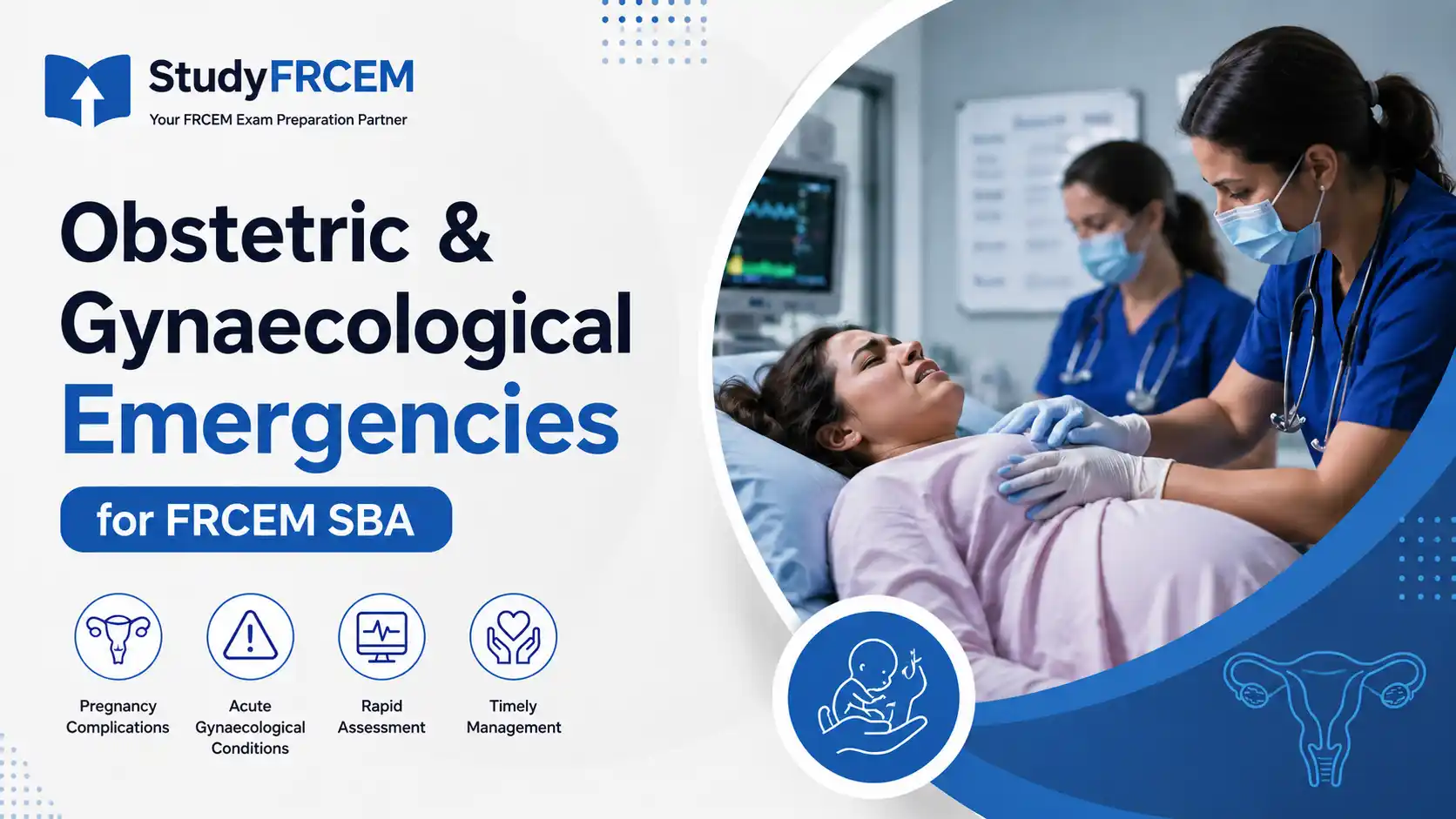

If there's one category in the FRCEM SBA that rewards precision over guesswork, it's obstetric and gynaecological emergencies. The blueprint consistently allocates marks to this domain, yet it's also where candidates lose easy points—not because the medicine is obscure, but because examiners love testing the exact threshold, the exact first-line drug, or the one detail that changes management.
This guide breaks down the highest-yield O&G emergencies for FRCEM SBA, the numbers you must memorize cold, and the traps examiners repeatedly set.
Ectopic Pregnancy — The Can't-Miss SBA Diagnosis
Now, the one thing that no one in the SBA would want to get right is an ectopic.
Classic stem: woman of reproductive age with unilateral lower abdominal pain, amenorrhea, and light PV bleeding. It's up to you to recognize it quickly and understand the serum hCG and ultrasound correlation.
It is never "too early to see" a positive urine or serum hCG with an empty uterus on transvaginal USS.
If hCG is elevated above the discriminatory zone in the absence of an intrauterine pregnancy on the scan, it indicates a strong possibility of an ectopic pregnancy.
Haemodynamic instability, if the pregnancy test is positive = immediate senior obstetric involvement and resuscitation (no 'wait for the scan')
The exam pitfall: When the patient is unstable, candidates tend to answer “repeat hCG in 48 hours.” When the woman has signs of rupture (peritonitis, tachycardia, hypotension), the right thing to do is not to do serial hCG tests but rather to take her to the gynecologist for resuscitation.
PV Bleeding in Early Pregnancy
Bleeding before 24 weeks covers a spectrum from threatened miscarriage to complete miscarriage, and SBAs test whether you can distinguish them using cervical os findings and ultrasound.
Threatened miscarriage: closed cervical os, viable pregnancy on scan
Inevitable/incomplete miscarriage: open os, products of conception present or partially passed
Complete miscarriage: empty uterus, os closed, symptoms resolving
Anti-D immunoglobulin is a frequent SBA sticking point. Know that Rh-negative women require Anti-D in specific early pregnancy bleeding scenarios (per RCEM and NICE guidance) — but routine Anti-D isn't automatically given for every episode of light spotting under 12 weeks with no instrumentation. Getting this nuance right often separates a pass from a near-miss answer.
Hyperemesis Gravidarum
Hyperemesis gravidarum questions test your ability to differentiate simple pregnancy sickness from a condition requiring admission.
The PUQE (Pregnancy-Unique Quantification of Emesis) score is the tool examiners expect you to know exists, even if they don't ask you to calculate it directly. Look for:
Weight loss exceeding 5% of pre-pregnancy body weight
Ketonuria on urinalysis
Electrolyte disturbance (particularly hyponatraemia or hypokalaemia)
First-line management per RCEM guidance is IV fluid rehydration and antiemetics such as cyclizine or promethazine, with more severe or refractory cases escalating to ondansetron or corticosteroids. A frequent exam trap is choosing an antiemetic contraindicated or less preferred in pregnancy — always default to the pregnancy-safe first-line option in your answer choice.
Hypertensive Disorders — Pre-eclampsia, Eclampsia & HELLP Syndrome
This is one of the highest mark-value, densest topics in the O&G emergency category, and SBA writers can't get enough of testing threshold numbers.
Pre-eclampsia: Elevated blood pressure (BP) ≥ 140/90 mmHg after 20 weeks' gestation and proteinuria
Severe pre-eclampsia: BP ≥160/110 mmHg, may have headache, visual disturbance, epigastric pain or hyperreflexia
Eclampsia: the same picture with tonic-clonic seizures.
Haemolysis: Elevated Liver enzymes and Low platelets—often associated with epigastric or Right upper quadrant pain, examiners often refer to this as a "biliary colic" or "gastritis" origin.
The loading dose and maintenance regimen are important to know about for magnesium sulphate use as a seizure prophylaxis and treatment drug. Also, be familiar with the signs of magnesium toxicity (loss of deep tendon reflexes and respiratory depression) because the antidote that the examiners expect you to choose if you are asked about magnesium toxicity is calcium gluconate.
A classic presentation of a lady who complains of a headache, RUQ pain, or a visual complaint is "silent" pre-eclampsia/HELLP syndrome. Be sure to read the BP and gestation clues in the vignette.
Antepartum and Postpartum Haemorrhage
There are two main differentials that the examiner tests when antepartum haemorrhage (APH) develops: bleeding after 24 weeks.
Placenta praevia: painless bleeding, soft, non-tender uterus.
Placental abruption: Slightly painful bleeding, woody-hard, tender uterus, and/or fetal distress due to the placenta separating from the womb.
Vaginal examination is a frequently tested safety-critical action that should never be done if there is a suspicion of placenta praevia until it is confirmed that the placenta has been located.
Postpartum haemorrhage (PPH) follows the "4 Ts" framework examiners expect you to recall instantly:
Tone — uterine atony (most common cause)
Trauma — genital tract lacerations
Tissue — retained placental fragments
Thrombin — coagulopathy
Management follows a stepwise escalation: uterine massage and oxytocics first-line, then additional uterotonics, tranexamic acid, and progression to surgical or interventional radiology options in massive haemorrhage. SBAs testing PPH usually want you to identify the correct sequence rather than jump straight to the most invasive option.
Maternal Sepsis and Cardiac Arrest in Pregnancy
Maternal sepsis is time-critical, and the Sepsis Six bundle applies with pregnancy-specific adjustments—fluid resuscitation, cultures, broad-spectrum antibiotics, lactate, oxygen, and urine output monitoring, all within the hour.
Cardiac arrest in pregnancy carries one of the most heavily tested facts in this entire domain: perimortem caesarean section should be performed within 4 minutes of arrest if the uterus is at or above the umbilicus, aiming for delivery by the 5-minute mark. This isn't a "nice to know"—it"'s a recurring SBA answer option designed to catch candidates who hesitate or choose to "wait for obstetric team arrival" instead of acting immediately.
Left lateral tilt or manual uterine displacement during CPR is another frequently tested detail—it relieves aortocaval compression and improves resuscitation efficacy.
Ovarian Torsion and Ruptured Ovarian Cyst
Ovarian torsion classically presents with sudden-onset, severe unilateral pelvic pain, often with nausea and vomiting out of proportion to examination findings.
Doppler ultrasound showing reduced or absent ovarian blood flow supports the diagnosis, though a normal Doppler doesn't fully exclude torsion
Risk factors include ovarian cysts, pregnancy, and ovulation induction
A ruptured ovarian cyst can mimic torsion or ectopic pregnancy—free fluid on USS with a resolving cyst is the differentiating clue
The exam trap: candidates often confuse torsion with appendicitis or PID due to overlapping right-sided pain presentations. Sudden onset and the degree of pain out of proportion to signs should tip you toward torsion.
Pelvic Inflammatory Disease
PID is characterized by bilateral lower abdominal pain, cervical motion tenderness, and adnexal tenderness, accompanied by fever and vaginal discharge.
Another good SBA "trap" for PID is Fitz-Hugh-Curtis syndrome (FHC), which is inflammation of the liver's perihepatic surface, which causes pain in the RUQ.
Treatment on first exposure to the clinic should be started as soon as a clinical likelihood is reached (before swab results)—first-line antibiotic treatment is usually a combination of coverage for gonorrhoea and chlamydia per local/national guidance—be aware of the risk of tubal damage and infertility if you don't treat with an antibiotic immediately after clinical likelihood.
High-Yield Exam Traps to Avoid
Choosing "repeat test in 48 hours" for an unstable patient instead of immediate action
Missing a disguised pre-eclampsia/HELLP stem hidden behind a headache or RUQ pain complaint
Performing a vaginal exam in suspected placenta praevia
Delaying perimortem C-section beyond the 4-minute window in maternal cardiac arrest
Confusing painless (praevia) versus painful (abruption) antepartum bleeding
Selecting a pregnancy-unsafe antiemetic or antibiotic option
Conclusion
Obstetric and gynaecological emergencies are not the most difficult subjects of the FRCEM SBA, they are the most targeted. Examiners are not testing if you are aware that these conditions exist; they are testing if you are aware of the threshold, the sequence, and the action/when that will get you from a safe clinician to a hesitant clinician. If you know the numbers above, know the disguised stems, and this category is one of your more reliable sources of marks, not one to dread.
If you want to drill these exact scenarios under exam conditions, StudyFRCEM's SBA question bank includes dedicated O&G emergency sets built around these high-yield thresholds and traps—a focused way to convert this knowledge into exam-day marks.
Frequently Asked Questions
What is the most tested O&G emergency in the FRCEM SBA?
Ectopic pregnancy and pre-eclampsia/HELLP syndrome appear most consistently. Both test threshold recognition and immediate management decisions.
Do I need to memorize exact drug doses for the SBA?
You should know key doses like magnesium sulphate for eclampsia and time-critical actions like the 4-minute perimortem C-section rule. Exact rare-drug dosing is less commonly tested than recognition and sequencing.
How does the SBA differentiate placenta praevia from abruption?
Praevia typically presents as painless bleeding with a soft uterus, while abruption presents as painful bleeding with a tender, tense uterus. Fetal distress is more associated with abruption.
Is PID commonly confused with other diagnoses in SBAs?
Yes, particularly appendicitis and ovarian torsion due to overlapping abdominal pain patterns. Bilateral tenderness and cervical motion tenderness point toward PID.
What's the biggest time-pressure trap in this category?
Maternal cardiac arrest questions, where hesitation over "waiting for the obstetric team" instead of immediate perimortem C-section is the most commonly tested wrong answer.