
If you've started digging into the FRCEM SBA application process, you've probably noticed something frustrating: half the guides online give you different answers. Some say you need six years of post-qualification experience. Others say four. Some still reference exam rules that RCEM quietly retired. The information isn't complicated—it's because a lot of it is outdated.
RCEM has revised the criteria for FRCEM SBA (and FRCEM OSCE) for exams starting from 2025, making the requirements to send for the exam and the assessment of experience easier to understand. The rules below are based on current rules for 2026 or later; pre-2025 rules are still alive on older blog posts and forum threads.
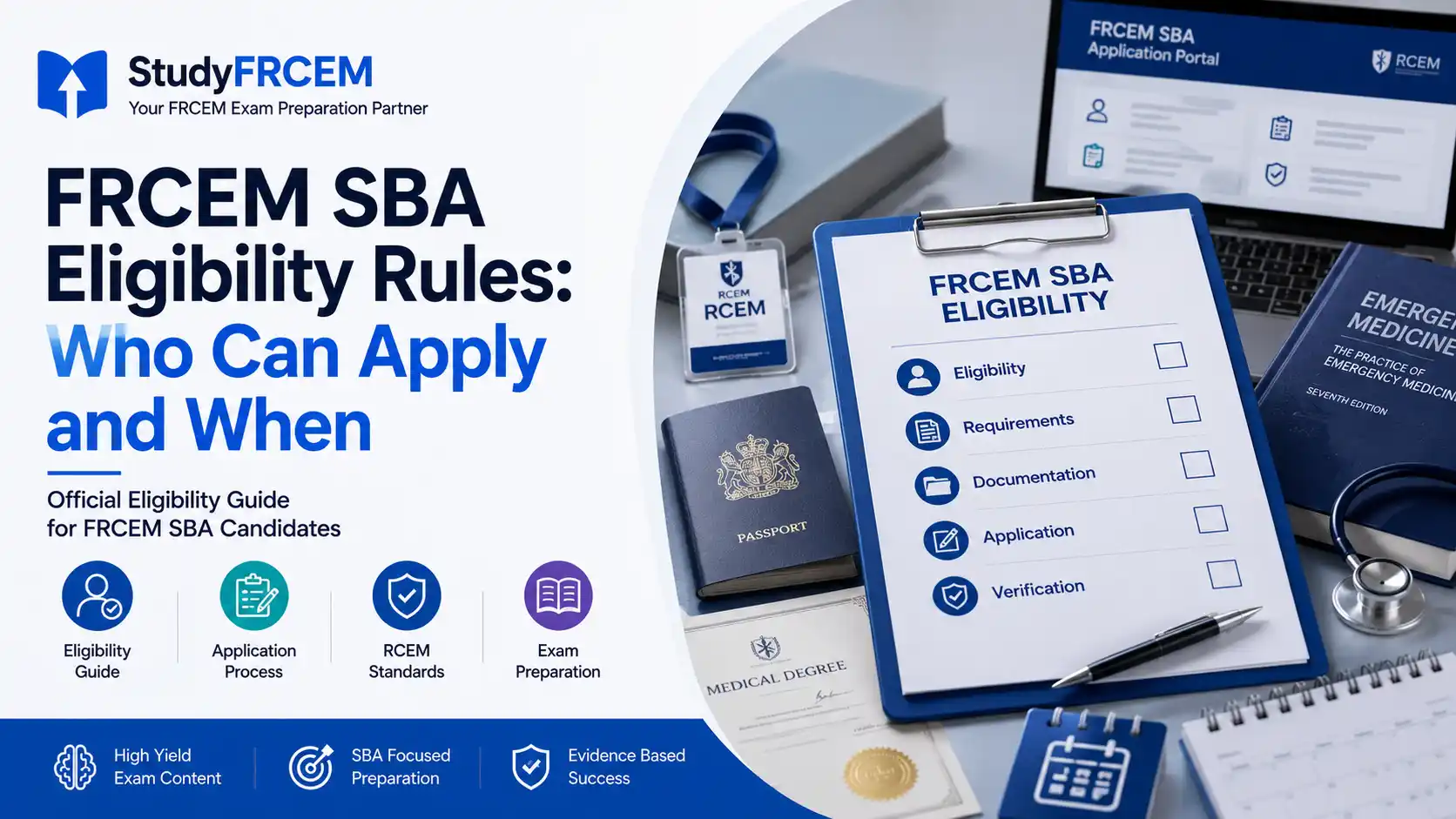
This guide takes you through who is eligible, when, and what commonly gets in the way of candidates when applying to the FRCEM SBA.
Quick Answer: FRCEM SBA Eligibility at a Glance
Before the detail, here's the shape of it:
You need a GMC-recognised primary medical qualification and full GMC registration with a licence to practise
You must have completed MRCEM (or hold equivalent standing accepted by RCEM)
UK trainees need 12 months full-time-equivalent Emergency Medicine experience at Higher Specialty Training level or equivalent
Non-trainees need 4 years full-time-equivalent EM training, with at least 1 year at higher specialty level
You must meet every criterion at the point you apply, not at the date of the exam itself
That last point catches more candidates out than anything else on this list. RCEM assesses your eligibility against the application date, so if you're a few weeks short of a threshold when the application window opens, applying anyway and hoping to "catch up" by exam day won't work.
The Core FRCEM SBA Eligibility Criteria
Every FRCEM SBA candidate, regardless of training pathway, has to satisfy three foundational requirements before RCEM even looks at their clinical experience.
Primary medical qualification (PMQ)
Your basic medical degree needs to be one that the GMC accepts for registration purposes. This is checked at the point of GMC registration, so if you're already fully registered with a licence to practise in the UK, this box is already ticked.
Full GMC registration with a licence to practise
You can't apply for the FRCEM SBA on a provisional or limited registration. RCEM needs to see that you're entitled to practice medicine independently in the UK at the point of application.
Completed MRCEM
The FRCEM is placed above the MRCEM in the pathway of the RCEM exam, meaning that you must pass all of your MRCEM components (or have recognised equivalent standing) before you can undertake the FRCEM. If you still have to do the MRCEM Primary or the MRCEM Intermediate SBA, then this is something you should bookmark for later instead of doing now.
Once these three are satisfied, RCEM moves on to assessing your clinical experience — and this is where the two pathways diverge.
UK Trainee Pathway: The 12-Month Rule
If you're in a UK or equivalent training program, RCEM asks for:
12 months full-time-equivalent Emergency Medicine experience
At the Higher Specialty Training level, or an equivalent grade
Time counted on an FTE basis, so part-time or less-than-full-time trainees can still qualify, it just takes proportionally longer to accrue the equivalent
A detail that surprises a lot of trainees: not every senior EM post counts automatically. Time spent in certain subspecialty rotations, such as standalone Paediatric Emergency Medicine or Pre-Hospital Emergency Medicine posts, may not count toward this requirement in the same way as generalist higher specialty EM training does. If your training pathway includes subspecialty blocks, it's worth checking with your Training Programme Director or directly with RCEM's Exams team before assuming a rotation counts.
Non-Trainee Pathway: 4 Years, With 1 at Higher Specialty Level
If you're not in a formal UK training program—this includes many international candidates, SAS doctors, and those training outside a recognised UK-equivalent scheme—the bar is higher:
4 years full-time-equivalent Emergency Medicine training in total
At least 1 of those years must be at higher specialty training level or equivalent
The remaining years can be at earlier or intermediate EM grades, but they need to be genuine EM training time, not just time spent in an EM department in an unrelated role
This pathway exists because non-trainees don't have the structured progression a UK training number gives you, so RCEM needs more cumulative evidence that you've reached consultant-adjacent decision-making capability before sitting an exam that assesses exactly that.
The 2025 Eligibility Update: What Actually Changed
This is worth understanding even if you're confident you meet the current criteria, because it explains why so much existing content contradicts itself.
RCEM introduced new eligibility criteria for all MRCEM and FRCEM exams from 2025 onwards, with two goals: simplifying what candidates need to submit for each specific exam, and introducing standardised currency rules in line with the Academy of Medical Royal Colleges best practice. Under the previous framework, non-trainee eligibility for the FRCEM SBA was commonly cited as six years post-qualification experience, with four of those years in Emergency Medicine and one at a level above ST3/SHO. Several currently published guides still describe this older non-trainee standard rather than the updated 4-years/1-year-higher-specialty framework, so if you're cross-referencing multiple sources and getting conflicting numbers, that's very likely why. When in doubt, RCEM's own Exam Eligibility and Adjustments page is the definitive source, and it's worth checking directly before you submit anything.
SBA or OSCE First? Order Doesn't Matter
One thing that hasn't changed: candidates can sit the FRCEM SBA and FRCEM OSCE in either order. There's no rule requiring you to pass the written component before attempting the clinical one, or vice versa.
That said, most candidates choose to sit the SBA first, partly because it can be booked at test centres worldwide, while the OSCE runs in-person in London only, which adds travel and cost considerations, especially for candidates based outside the UK.
Exam Currency Rules: The 7-Year Windows
RCEM's currency rules govern how long your progress "counts for" once you start passing components, and they apply in stages:
You have 7 years to complete all MRCEM exams from when you begin
Once MRCEM is complete, you have 7 years to take and pass your first FRCEM component (SBA or OSCE)
Once you've passed your first FRCEM component, you have a further 7 years to complete the second
For example, a candidate who completes MRCEM in December 2024 needs to pass at least one FRCEM component by December 2031. If that candidate then passes the FRCEM SBA in, say, 2028, the clock resets for the OSCE: they'd have until 2035 to complete it.
If you're worried about a currency window closing on you — because of parental leave, long-term sick leave, or other approved time out of training — RCEM does consider case-by-case extensions. You'd need to email the Exams team before your currency expires, since extensions generally aren't backdated once a window has lapsed.
Attempt Limits: You Get Four Tries
Each FRCEM component carries its own cap:
Maximum 4 attempts at the FRCEM SBA
Maximum 4 attempts at the FRCEM OSCE, counted separately
Attempts taken after August 2016 count toward this limit; earlier attempts generally don't, provided you haven't already exceeded the cap
Additional attempts beyond four may be granted in exceptional circumstances, at the discretion of the College
This is a big part of why understanding eligibility properly before you apply matters. Turning up underprepared and using an attempt on an exam you weren't fully ready for isn't just a wasted fee, it's one of only four chances, permanently used.
When You're Not Eligible
A few common scenarios that mean you're not ready to apply, even if you feel ready clinically:
You haven't completed MRCEM, or your equivalent standing hasn't been formally recognised by RCEM
Your GMC registration is provisional, restricted, or lapsed
Your EM training time falls short of the FTE thresholds once part-time working is converted to full-time equivalent
A significant portion of your "EM experience" was in a subspecialty post that doesn't count toward the general EM training requirement
You're relying on the older six-year non-trainee criteria instead of the current 4-years/1-year framework, and haven't actually met the updated requirement
If any of these sound like they might apply to you, it's worth checking directly with RCEM's Exams team rather than guessing, since an unsuccessful or rejected application can cost you time in an already tight currency window.
How to Apply Once You're Eligible
Applications open through your RCEM account during a published application window, which opens at a set time on the opening date and closes automatically on the closing date. Late applications aren't accepted under any circumstances, so it's worth diarising the window well in advance rather than relying on a reminder email.
RCEM also offers a self-assessment eligibility quiz as a guide, though it's exactly that: a guide, not a guarantee. Every application is reviewed individually against the full criteria, so use the quiz to sense check yourself, then confirm anything borderline with the Exams team directly before you submit.
How to Prepare Once You're Eligible
Confirming eligibility is step one. The exam itself is a different challenge entirely: 180 single best answer questions across two papers, mapped to the full RCEM 2021 curriculum, with a pass rate that regularly sits under 50%. It rewards candidates who've trained specifically for consultant-level decision-making, not just broad EM knowledge.
That's the gap StudyFRCEM is built to close. Every question in our bank is mapped to the exact RCEM Specialty Learning Outcome it tests, written and reviewed by doctors who've sat and passed the exam themselves, and kept current as guidelines change so you're never revising outdated medicine while the exam has already moved on.
Conclusion
Eligibility rules for the FRCEM SBA aren't complicated once you're working from the current criteria, but they are unforgiving of guesswork, especially with only four attempts and multi-year currency windows in play. Confirm your standing directly against RCEM's current published criteria before you apply, not against whatever guide you found first.
Once you've confirmed you're eligible, the real work starts. Register with StudyFRCEM to access a question bank built specifically around the current RCEM 2021 SLO blueprint, with explanations written by doctors who've been exactly where you are now.
Frequently Asked Questions
Do I need to complete MRCEM before applying for the FRCEM SBA?
Yes, you need to have passed MRCEM or hold recognised equivalent standing before FRCEM becomes available. This applies regardless of which training pathway you're on.
Can international candidates apply for the FRCEM SBA?
Yes, non-trainees including international candidates, can apply under the non-trainee pathway, which requires 4 years of FTE EM training with at least 1 year at higher specialty level.
Do I have to sit the FRCEM SBA before the FRCEM OSCE?
No, candidates can sit either component first. Most choose the SBA first partly because it's available at test centers worldwide, unlike the OSCE.
Does time in a Paediatric or Pre-Hospital EM post count toward eligibility?
Not always. Subspecialty rotations like standalone PEM or PHEM training may not count toward the general EM training requirement, so it's worth confirming with RCEM directly.
What happens if I don't pass the FRCEM SBA within my 7-year currency window?
You may be required to resit an already-passed component if the other one isn't completed in time, subject to your remaining attempts. Extensions are considered case-by-case for approved circumstances like parental or long-term sick leave.