
You've just seen the word "unsuccessful" on your results screen. The months of late-night studying, sacrificed weekends, and exhausted revision sessions — and it still wasn't enough.
If you're feeling devastated or questioning yourself right now, hear this: failing FRCEM does not mean you've failed as a doctor.
With a 53% failure rate, more than half of all candidates don't pass first time. Many now-successful consultants failed once or twice. What separates those who eventually pass isn't ability — it's how they respond.
This Is Normal — The Numbers Prove It
53% of candidates fail each sitting
Average successful candidate requires 1.8 attempts
Second-attempt pass rate (50–55%) is higher than first attempt (40%)
You're part of a large group experiencing the same disappointment right now. Allow yourself 48 hours to process it before switching into problem-solving mode.
Why Did You Fail? The Four Main Causes
Be honest with yourself here. Self-deception guarantees repeat failure.
1. Poor time management (35% of failures) Did you leave questions blank or rush the final section? This is the most common cause. All 180 questions must be completed — there is no negative marking, so a blank answer is a guaranteed zero. See our FRCEM SBA time management guide for a full pacing strategy.
2. Weak SLO coverage (30% of failures) Did you neglect professional domains — SLO 10 (statistics), SLO 7 (complex situations), SLO 12 (leadership)? These are predictable marks that many candidates simply avoid. Check your RCEM results feedback: it gives you an SLO-by-SLO breakdown showing exactly where you underperformed.
3. Insufficient question practice (20% of failures) Fewer than 2,000 practice questions leaves candidates underprepared for the pace and pattern recognition the exam demands. Research on how many questions you actually need consistently points to 2,000–2,500 as the evidence-based target.
4. Inefficient study methods (15% of failures) Starting too late, using outdated or non-SLO-mapped resources, and not tracking weak areas by domain — particularly common for doctors studying while working full time.
The Resit: What You Need to Know
Attempts: Maximum 4 total.
Timing: You must wait at least one exam sitting (~3–4 months). If you have major knowledge gaps, waiting two sittings (6–7 months) is advisable.
Feedback: Use your RCEM SLO breakdown — this is your most valuable resit tool. It tells you exactly which domains to prioritise.
Registration: Same process as your first attempt via the RCEM website. No special resit category exists.
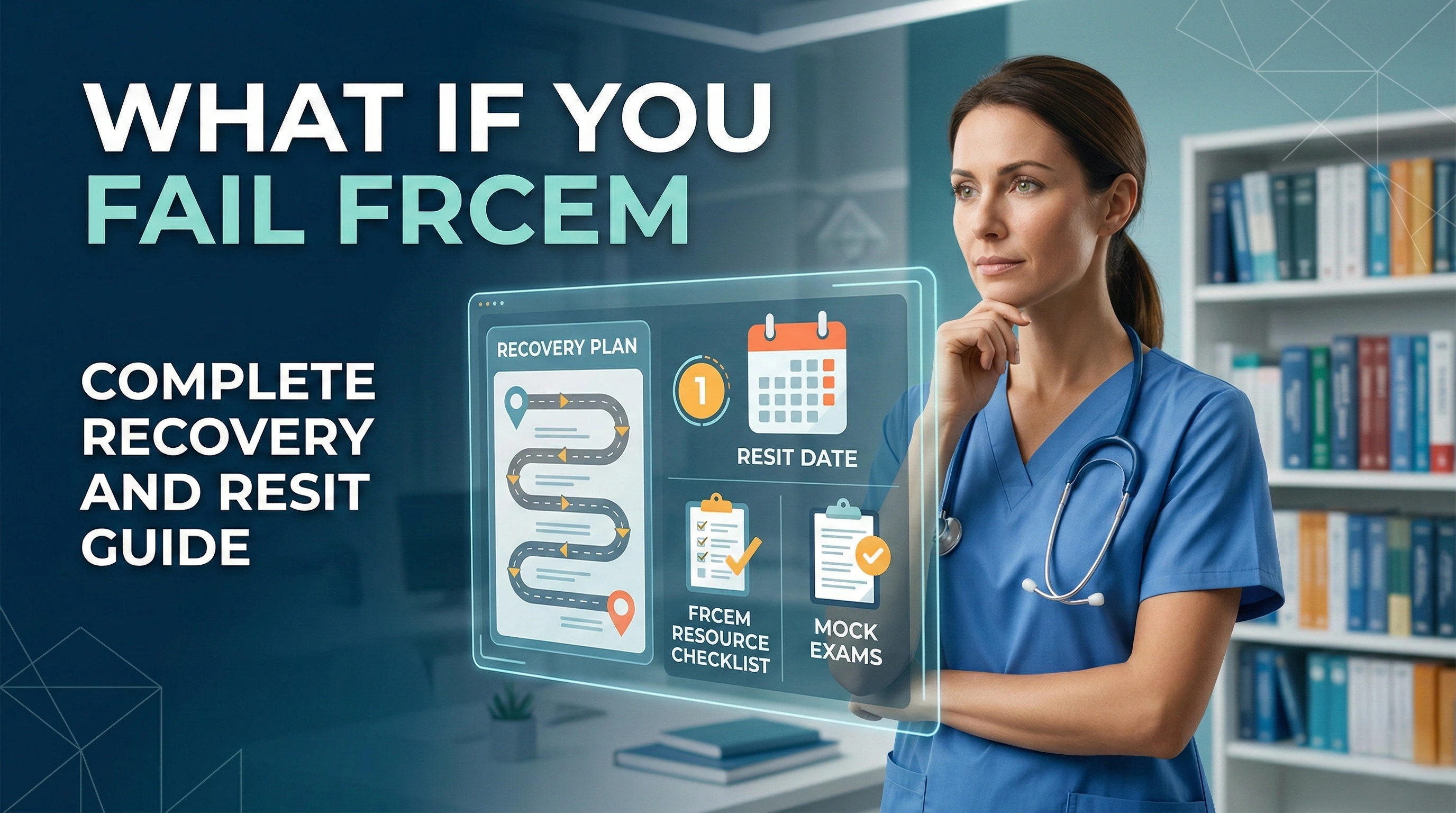
Your Resit Strategy (Based on Why You Failed)
If time management was the issue (3–4 month resit):
Month 1: 90-question blocks under strict 2-hour time limits
Month 2: Weekly full 180-question mocks under exam conditions
Months 3–4: Daily timed blocks on weak SLOs; consolidation
If weak SLO coverage was the issue (6 month resit):
Months 1–2: Deep focus on your 3 weakest SLOs with targeted questions
Months 3–4: Balanced practice across all SLOs
Months 5–6: Full mocks and weak-area consolidation
If insufficient preparation was the issue (6–7 month resit): Follow the complete first-attempt preparation strategy from scratch. Commit to 2,000+ questions and weekly mocks from month 3.
What to Do Differently This Time
First Attempt | Resit Approach |
|---|---|
General practice, no SLO tracking | Track performance by SLO throughout |
Untimed practice until final weeks | Timed practice from day one |
2–3 full mock exams | 8–10 full 180-question mocks |
Equal time on all topics | 60% time on weak SLOs, 40% maintaining strengths |
Free or outdated materials | SLO-mapped question bank with detailed explanations |
Common Resit Mistakes to Avoid
Rushing back too soon. Resitting in 6–8 weeks without addressing root causes guarantees repeated failure. Fix the fundamentals first.
Repeating the same preparation. If your first approach didn't work, doing it again won't help. Change your strategy based on what went wrong.
Overconfidence about knowing the format. Familiarity with the exam does not compensate for knowledge gaps or poor time management.
Avoiding weak areas. Practising comfortable topics feels productive but won't fix what failed you.
The Second-Attempt Advantage
Resit candidates have real advantages over first-timers:
You know the exam format — no surprises on question style or timing
You have SLO-specific data — you know exactly where to focus
You respect the difficulty — no false confidence going in
You're more motivated — the sting of failure drives focused preparation
Second-attempt pass rates exceed first-attempt rates for precisely these reasons. Candidates who analyse failure honestly and adjust strategy accordingly often pass convincingly.
Frequently Asked Questions
Will failing affect my career?
No. Once you pass, nobody cares how many attempts it took. Your CCT and consultant applications show "FRCEM achieved [year]" — attempt numbers are never disclosed.
Can I resit while working full time?
Yes — most resit candidates do. The key is structured planning and a realistic timeline. Our guide to studying while working covers this in detail.
What if I fail a second time?
You have up to 4 attempts. If a second attempt fails despite genuine strategy change, consider formal courses, study leave, or mentorship before attempting again.
Should I tell my educational supervisor?
Yes — be proactive. Present your analysis of what went wrong and your specific resit plan. Most supervisors are supportive; many failed exams themselves during training.
Failing FRCEM is a temporary setback, not a permanent barrier. What matters now is responding productively: analyse what went wrong, change your approach, and commit to systematic improvement.
The difference between eventually passing and repeated failure isn't ability — it's strategic, honest preparation adjustment.
Ready to build a targeted resit strategy? Register with StudyFRCEM for SLO-mapped question practice designed to address your specific weak areas.