
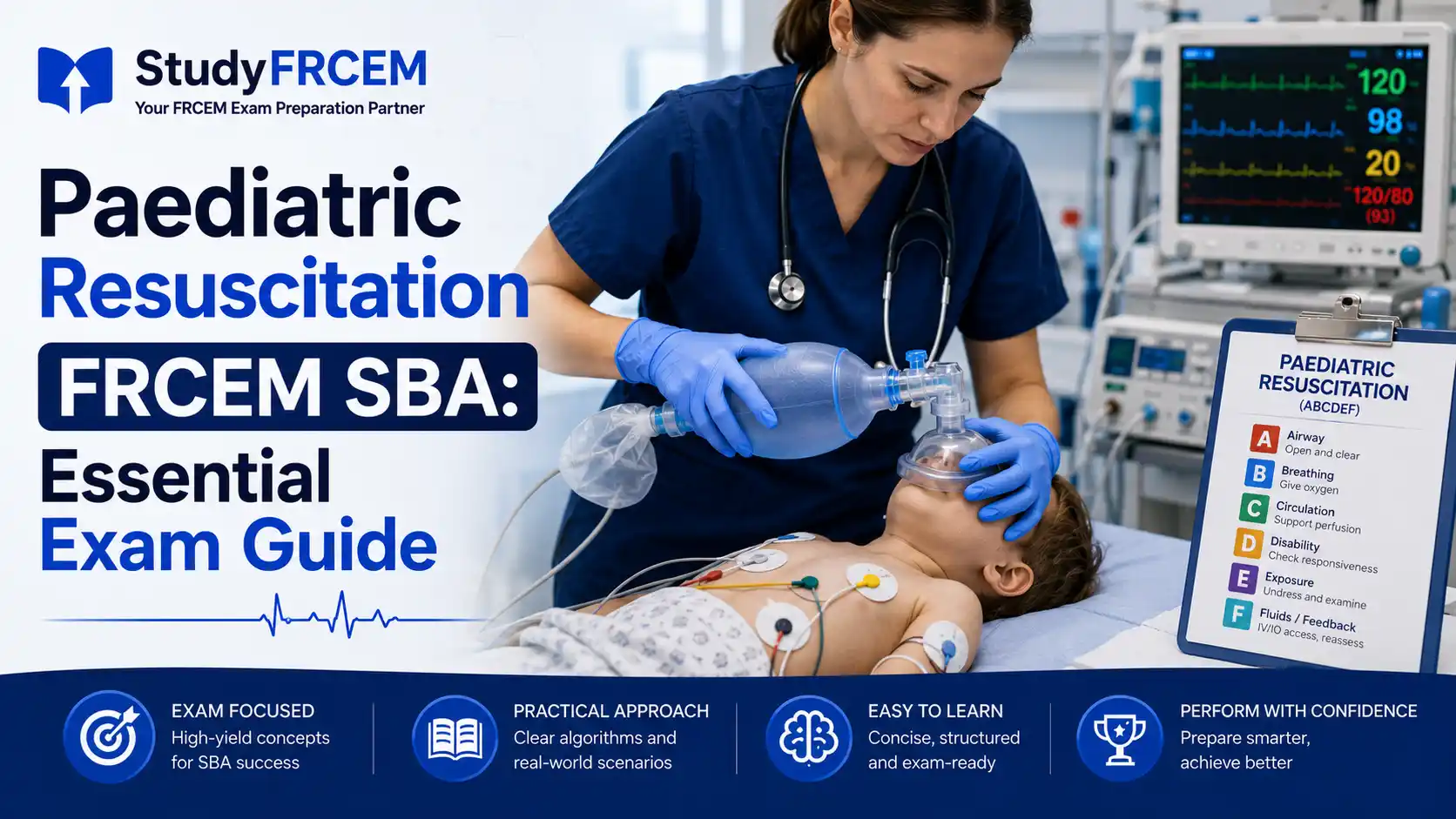

Paediatric resuscitation is one of the few topics in the FRCEM SBA that examiners can pull from two directions at once. It sits under SLO3 (Resuscitation) and SLO5 (Paediatric Emergency Medicine), and RCEM's 2025 curriculum update specifically strengthened the paediatric resuscitation capabilities within SLO5 — which tells you the exam is only going to lean harder into this area, not less.
The clinical concepts aren't complicated. What trips candidates up is precision: the exact energy for a shock, the exact adrenaline dose, the exact sequence of a choking algorithm, and knowing which version of the guideline is currently in force. This guide walks through paediatric resuscitation the way the SBA actually tests it, including the 2025 Resuscitation Council UK update that most question banks haven't caught up with yet.
Why the FRCEM SBA Weighs Paediatric Resuscitation So Heavily
SLO5 covers roughly 30 of the 180 marks on the SBA, making it one of the highest-yield areas after SLO3 (resuscitation, ~40 marks) and on par with SLO1 and SLO4. RCEM defines a "child" as anyone up to their 18th birthday for the paediatric algorithm — a detail examiners occasionally test directly, since a 17-year-old trauma patient still falls under paediatric protocols even though they may look and behave like an adult.
The exam also expects you to lead, not just participate. SLO5 explicitly requires trainees to be entrusted with leading paediatric resuscitation through to disposal, including running a debrief afterwards. That leadership angle shows up in SBA stems as questions about who should be doing what during an arrest, not just what the next clinical step is.
Recognising the Sick Child — The ABCDE Approach Examiners Expect
Before any resuscitation algorithm starts, the SBA tests whether you can recognize that a child needs one. A structured ABCDE assessment remains the expected approach:
Airway — patency, stridor, hoarse voice
Breathing — work of breathing, respiratory rate for age, SpO2, wheeze, cyanosis
Circulation — heart rate for age, capillary refill time, blood pressure relative to the 5th centile for age
Disability — conscious level (AVPU), glucose
Exposure — rash, temperature
The trap examiners build in most often normal ranges. A heart rate or respiratory rate that would be alarming in an adult can be entirely normal in an infant, and vice versa. Question stems frequently embed a full set of observations specifically so you can calculate whether they're abnormal for that child's age, rather than answering from gut feel.
Paediatric Basic Life Support (PBLS) — The Sequence the SBA Tests
Once cardiorespiratory arrest is suspected, the in-hospital PBLS sequence is
Check responsiveness and call for help (activate 2222)
Open the airway and give 5 rescue breaths
If no signs of life are seen during those breaths, start chest compressions immediately
Continue at a ratio of 15 compressions to 2 breaths
Attach a defibrillator as soon as one is available
A common SBA distractor swaps this ratio for the adult 30:2 or removes the initial 5 rescue breaths entirely. Both are wrong for the in-hospital paediatric pathway — the 5 initial breaths matter because paediatric arrests are far more often respiratory in origin than adult arrests, and oxygenation takes priority from the first action.
Out-of-hospital BLS differs slightly: a single lay rescuer without paediatric-specific training can default to the adult 30:2 sequence they already know, since some CPR is always better than none. The SBA sometimes tests this exact nuance—that rescuers unfamiliar with paediatric ratios shouldn't be paralyzed into inaction by not knowing the "correct" paediatric ratio.
Paediatric Advanced Life Support — Shockable vs Non-Shockable Pathways
Once a defibrillator is attached, the rhythm dictates the pathway.
Shockable (VF/pulseless VT):
Give an immediate shock, then resume CPR for 2 minutes with minimal interruption
Reassess rhythm after every 2-minute cycle
After the 3rd shock, give adrenaline 10 mcg/kg IV/IO and amiodarone 5 mg/kg IV/IO
Repeat adrenaline every 3–5 minutes thereafter
Give a second dose of amiodarone (5 mg/kg) only after the 5th shock, if still shockable
Non-shockable (PEA/asystole/bradycardia <60/min with poor perfusion):
Give adrenaline 10 mcg/kg IV/IO as soon as possible, then every 3–5 minutes
Resume CPR immediately after each rhythm check, minimizing interruptions
The SBA's favourite trap here is timing. Candidates who know the drugs but not the sequencing will sometimes select "give adrenaline before the first shock" for a shockable rhythm—but in VF/pVT, adrenaline is withheld until after the 3rd shock, not given upfront. In non-shockable rhythms, by contrast, current guidance emphasises adrenaline as early as possible, which is the opposite emphasis and a frequent source of confusion between the two pathways.
Defibrillation Energy and Drug Doses — What Changed in the 2025 Update
This is the section where outdated question banks cause the most damage, because the numbers moved in 2025.
First shock: 4 J/kg (unchanged)
Refractory VF/pVT after the 5th shock: energy now escalates stepwise up to a maximum of 8 J/kg (max 360 J) — this stepwise escalation to 8 J/kg is new under the 2025 Resuscitation Council UK guidance; the previous approach simply repeated 4 J/kg throughout.
Adrenaline: 10 mcg/kg IV/IO, maximum single dose 1 mg
Amiodarone: 5 mg/kg IV/IO, maximum single dose 300 mg after the 3rd shock, and 150 mg after the 5th shock
Fluid bolus: 10 mL/kg of balanced isotonic crystalloid (or 0.9% saline)
Glucose (for confirmed hypoglycaemia): 2 mL/kg of 10% glucose
A candidate revising from a 2021-era source may confidently select "repeat 4 J/kg" for a refractory shockable rhythm—a distractor that would have been correct several years ago but isn't now. This is exactly the kind of trap the SBA rewards candidates for catching, because it separates those revising from current guidance from those relying on memory of what they learned during training.
Weight-based dosing is also tested directly: stems often give a child's weight and ask you to calculate the correct adrenaline volume, expecting you to know the drug is prepared as 1:10,000 (100 mcg/mL) for cardiac arrest use — distinct from the 1:1,000 concentration used for IM adrenaline in anaphylaxis.
Fluid Resuscitation in Paediatric Shock
For a shocked child without cardiac arrest, the SBA expects:
10 mL/kg boluses of balanced crystalloid (or 0.9% saline if balanced fluids aren't available)
Reassessment after every bolus, watching for signs of fluid overload (hepatomegaly, crackles at the lung bases)
Escalation to inotropic or vasoactive support if shock persists despite repeated boluses, rather than continuing indefinite fluid challenges
In suspected septic shock specifically, current guidance favours earlier consideration of vasoactive infusions (adrenaline or noradrenaline) once fluid-refractory shock is identified, rather than pushing large volumes of fluid alone. A stem describing a child who remains hypotensive after 40 mL/kg of fluid is testing whether you'll escalate to vasoactive support rather than select "further fluid bolus" as the answer.
Paediatric Choking (Foreign Body Airway Obstruction) Algorithm
The choking algorithm is short but an exam-favorite territory because every step depends on two branch points: is the cough effective, and is the child conscious?
Effective cough: encourage coughing, monitor continuously for deterioration
Ineffective cough, conscious:
Infant—5 back blows alternating with 5 chest thrusts
Child—5 back blows alternating with 5 abdominal thrusts
Ineffective cough, unconscious: open the airway, attempt rescue breaths, and move straight into the paediatric BLS sequence
A frequently tested distractor is applying abdominal thrusts to an infant—these are reserved for children, not infants, because of the risk to abdominal organs. Blind or repeated finger sweeps are also explicitly avoided at every stage, another detail examiners like to slip into the wrong answer option.
Reversible Causes — The 4 Hs and 4 Ts in Exam Stems
Every cardiac arrest scene should prompt a search for reversible causes and run in parallel with—not instead of—high-quality CPR:
Hypoxia
Hypovolaemia
Hyper-/hypokalaemia, hypocalcaemia, hypomagnesaemia, hypoglycaemia
Hypo-/hyperthermia
Thrombosis (coronary or pulmonary)
Tension pneumothorax
Tamponade (cardiac)
Toxins
In paediatric traumatic cardiac arrest specifically, the SBA may expect you to prioritize treating a reversible cause—such as needle decompression for tension pneumothorax or haemorrhage control — before or alongside adrenaline, since a mechanical or hypovolaemic cause won't respond to drugs alone.
Common FRCEM SBA Traps in Paediatric Resuscitation Questions
Giving adrenaline before the 3rd shock in a shockable rhythm, rather than withholding it until after
Repeating 4 J/kg for refractory VF/pVT instead of escalating stepwise to 8 J/kg under the 2025 update
Using the adult 15:2 → 30:2 ratio incorrectly, or applying out-of-hospital rules to an in-hospital scenario
Choosing abdominal thrusts for a choking infant instead of chest thrusts
Selecting "further fluid bolus" as the answer for a child already showing signs of fluid overload
Worked SBA-Style Practice Question
A 4-year-old boy (weight 16 kg) is brought into resus in cardiac arrest. CPR is ongoing. The defibrillator is attached, and the rhythm shows VF. He has already received 5 shocks, adrenaline after the 3rd and 5th shocks, and amiodarone after the 3rd and 5th shocks. He remains in VF.
What is the most appropriate next step for the 6th shock?
A. Repeat the shock at 4 J/kg
B. Increase the energy to 8 J/kg
C. Withhold further shocks and give a third dose of amiodarone
D. Switch to synchronised cardioversion
E. Stop resuscitation as the rhythm is refractory.
The correct answer is B. This is refractory VF/pVT beyond the 5th shock, and under the 2025 Resuscitation Council UK update, energy should now escalate stepwise up to a maximum of 8 J/kg (max 360 J), rather than repeating the standard 4 J/kg. Amiodarone is only given twice in total—after the 3rd and 5th shocks—so option C is incorrect, and synchronised cardioversion (D) has no role in a shockable cardiac arrest rhythm.
Conclusion
Paediatric resuscitation rewards precision far more than it rewards general clinical instinct. The concepts—recognize the sick child, follow the algorithm, and treat reversible causes—are ones most candidates already understand. What separates a pass from a near-miss is knowing the current numbers: 4 J/kg first shock, 8 J/kg cap for refractory VF/pVT, 10 mcg/kg adrenaline, and the exact sequencing of drugs against shocks under the 2025 guideline update.
If you want to test this knowledge properly before exam day, StudyFRCEM's question bank includes SLO-mapped, consultant-written paediatric resuscitation scenarios built around the current Resuscitation Council UK algorithms — so you're practising against 2025-updated standards, not an earlier version of the guideline.
Frequently Asked Questions
What is the first shock energy for paediatric defibrillation?
The first shock is given at 4 J/kg, regardless of whether the rhythm is VF or pulseless VT.
What changed in the 2025 paediatric resuscitation update?
Refractory VF/pVT after the 5th shock now escalates stepwise up to a maximum of 8 J/kg (max 360 J), rather than repeating 4 J/kg throughout.
When is adrenaline given in a shockable rhythm?
Adrenaline is withheld until after the 3rd shock, then repeated every 3–5 minutes, unlike non-shockable rhythms where it's given as soon as possible.
What is the correct compression-to-ventilation ratio for in-hospital paediatric BLS?
15 compressions to 2 breaths, preceded by 5 initial rescue breaths before compressions begin.
Should abdominal thrusts be used for a choking infant?
No. Infants receive back blows alternating with chest thrusts; abdominal thrusts are reserved for children due to the risk of organ injury.