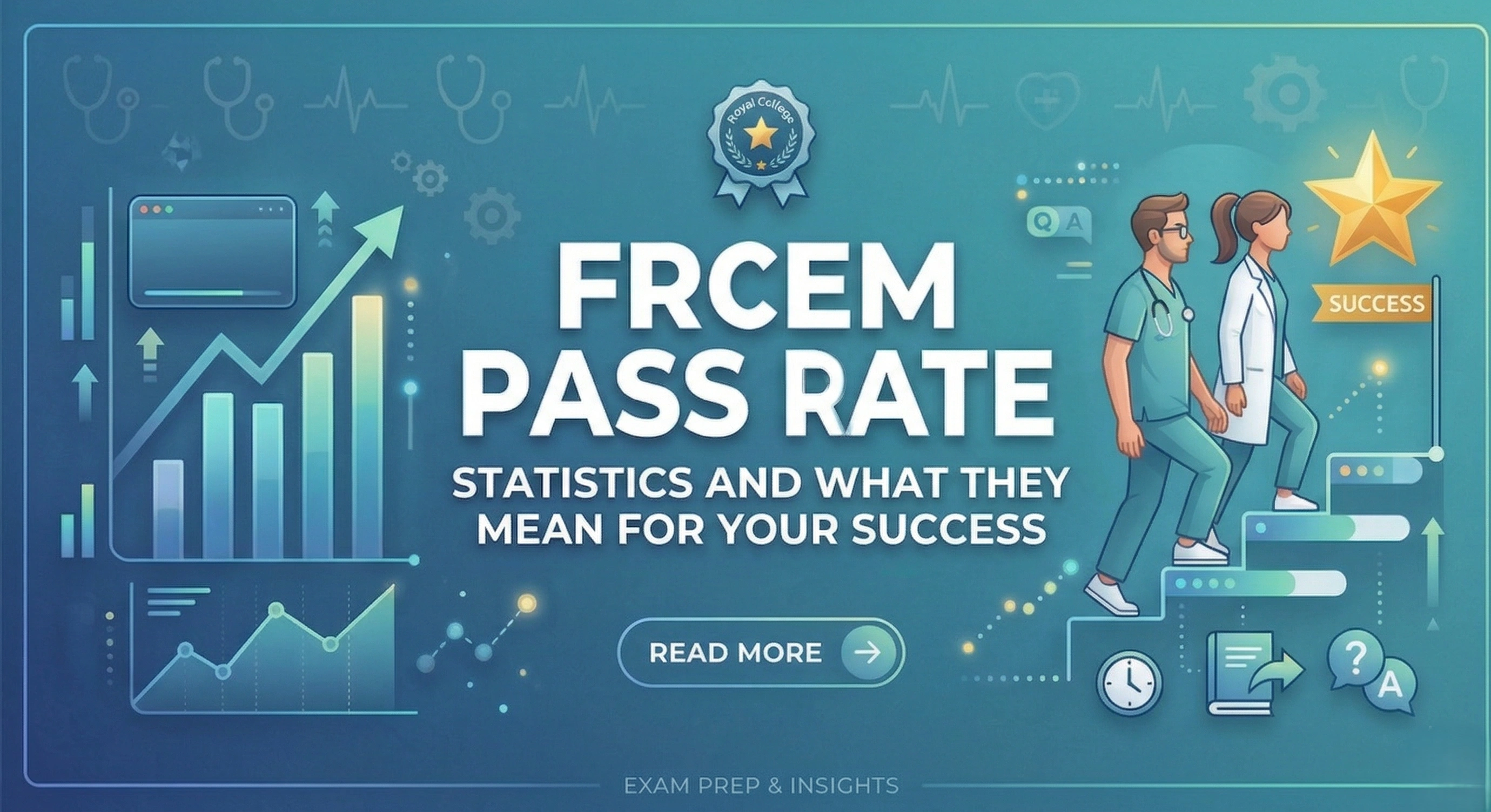

Every FRCEM candidate wants to know: "What are my chances?" The numbers are sobering — but they tell a more nuanced story than simple success or failure.
Current FRCEM Pass Rates
Based on recent RCEM published data:
FRCEM SBA (Written Exam)
2024 overall pass rate: 45–48% (varies by sitting)
Pass mark: typically 60% (108/180 questions), adjusted ±2% based on exam difficulty
Target 70%+ in practice to build a safe margin
FRCEM OSCE (Clinical Exam)
Pass rate: 50–55%
From November 2025, candidates must pass at least one resuscitation station
Pass mark set using the borderline regression method
Combined Fellowship
~40–45% pass both components on the first complete attempt
Average candidate requires 1.8 attempts overall
What These Numbers Actually Mean
It's Not a Competition
FRCEM uses criterion-referenced standard setting — you are not ranked against other candidates. The pass mark reflects expected borderline consultant-level competence. If you meet the standard, you pass. The 47% figure shows how many candidates currently meet that standard, not an artificial quota.
If you're wondering what that standard actually looks like in practice, our guide on how hard the FRCEM exam really is breaks down the difficulty level in detail.
Pass Marks Adjust for Difficulty
Using the modified Angoff method, harder papers carry a slightly lower pass mark; easier papers a slightly higher one. This maintains consistent standards across sittings. Do not choose your exam date based on rumours of "easier" sittings — they do not exist. Always target 70%+ in practice regardless.
Why Do 53% of Candidates Fail?
Analysis of unsuccessful attempts reveals four consistent patterns:
1. Poor time management (35% of failures) — Candidates run out of time and leave questions blank. There is no negative marking, so an unanswered question is a guaranteed zero. All 180 questions must be completed. A structured pacing strategy is essential — see our FRCEM SBA time management guide for a question-by-question approach.
2. Neglecting professional domains (25% of failures) — SLO 10 (statistics/research), SLO 7 (complex situations), and SLO 12 (leadership) are frequently ignored. These cover 25+ questions and are highly predictable. Skipping them costs 15–20 achievable marks.
3. Insufficient question practice (20% of failures) — Candidates who complete fewer than 2,000 practice questions are underprepared for the pace and pattern recognition required. Textbook reading alone does not develop exam technique. Our research into how many practice questions you actually need consistently points to 2,000–2,500 as the benchmark.
4. Inefficient study methods (15% of failures) — Starting too late, using outdated or non-SLO-mapped materials, and not tracking weak areas by domain all create knowledge gaps that cost marks. This is especially common among doctors preparing while working full time.
What Distinguishes Passing Candidates?
Factor | Passing Candidates | Failing Candidates |
|---|---|---|
Preparation timeline | 6 months, structured | 6–8 weeks, ad hoc |
Practice questions | 2,000–2,500 with review | <1,500, rushed |
SLO coverage | All domains, inc. professional | Clinical topics only |
Mock exams | Full 180-question mocks from month 3 | Untimed until final weeks |
Mock exam scores | Consistently 70–75%+ | Below 65%, often static |
For a complete breakdown of what a structured 6-month plan looks like, see our step-by-step guide to passing FRCEM on your first attempt.
Your Realistic Chances of Passing
Your individual probability depends on preparation quality, not aggregate statistics.
High probability (70–80%): 6+ months structured preparation, 2,500+ questions completed, consistently scoring 70–75%+ on full mocks, all weak SLO areas addressed.
Moderate probability (50–60%): 4–5 months preparation, 1,800–2,200 questions, scoring 65–70% on mocks, some weak areas remaining.
Low probability (20–30%): Less than 3 months preparation, fewer than 1,500 questions, scoring below 60% on mocks, multiple weak domains unaddressed.
The statistics describe aggregate outcomes — they do not predetermine yours.
Month-by-Month Preparation Targets
Months 1–2: Foundation in high-weighted SLOs (1, 3, 4, 5). Complete 400–600 questions. Target 50–60% accuracy (learning phase).
Months 3–4: Expand to all SLOs including professional domains. Complete 800–1,000 questions. Target 60–70% accuracy. Weekly 90-question timed mocks.
Months 5–6: Full 180-question mocks twice weekly. Complete final 800–900 questions. Target 70–75%+ consistently. Address only persistent weak areas.
Mock score guide:
75%+ consistently → very likely to pass
70–75% → likely to pass
65–70% → borderline, continue preparation
60–65% → defer if possible
Below 60% → seriously consider deferring
Frequently Asked Questions
Is FRCEM harder than MRCEM?
Yes. FRCEM tests consultant-level clinical decision-making; MRCEM tests registrar-level knowledge. The MRCEM pass rate is lower (~30–35%), but FRCEM demands a higher standard of reasoning and application.
What percentage do I need to pass?
Typically 60% (108/180), adjusted slightly based on exam difficulty. Always target 70%+ in practice.
Do international candidates have lower pass rates?
RCEM does not publish stratified data, but international candidates face added challenges with UK-specific guidelines, medicolegal frameworks, and clinical practice patterns. Extra preparation in these areas is advisable.
If I fail the first time, should I change strategy?
Yes. Candidates who analyse their first-attempt performance and adjust accordingly pass at a higher rate on the second attempt (~50–55%). Repeating the same approach with the same resources rarely changes the outcome.
The 47% pass rate reflects genuine exam difficulty — not an artificial barrier. Six months of structured, SLO-mapped preparation with 2,000+ quality practice questions consistently places candidates in the passing majority. The question is not whether the exam is passable — clearly it is. The question is whether your preparation will be adequate.
Ready to improve your pass probability? Register with StudyFRCEM for comprehensive, SLO-mapped question practice built for first-attempt success.