
Starting emergency medicine training in the UK means navigating a progression of exams that can seem confusing at first. The most common question trainees ask: "What's the difference between MRCEM and FRCEM, and which comes first?"
Understanding this pathway is crucial for planning your training timeline, choosing appropriate study resources, and knowing when you're eligible to sit each component.
Here's everything you need to know about the MRCEM and FRCEM exam structure, requirements, and progression.
The Simple Answer: MRCEM Comes First
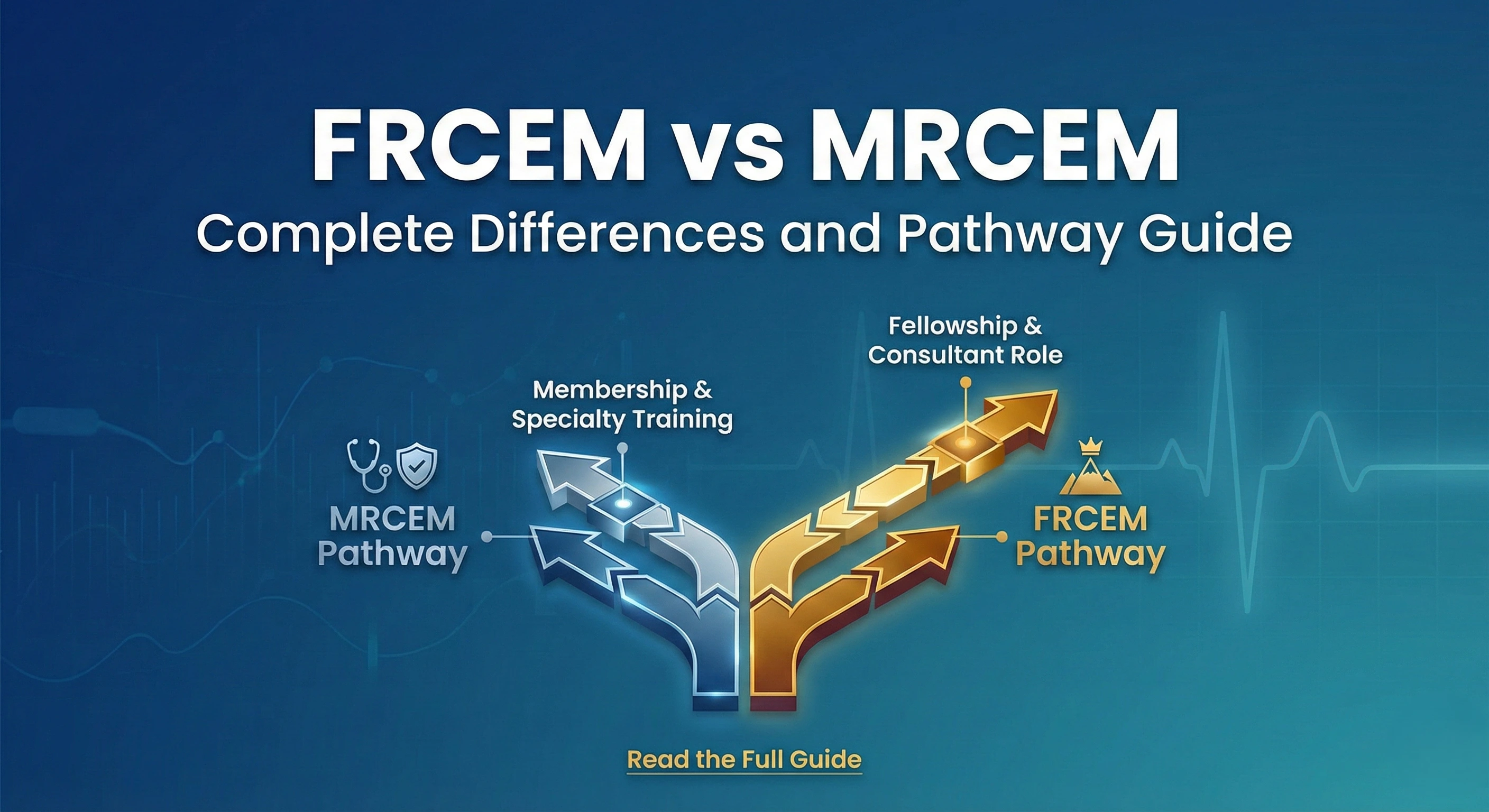
MRCEM (Membership of the Royal College of Emergency Medicine) is the foundation exam you complete during ST1-3 training. FRCEM (Fellowship of the Royal College of Emergency Medicine) is the advanced exam you sit at ST4-6 level.
The pathway:
Complete MRCEM (ST1-3 level)
Progress to ST4 training
Complete FRCEM (ST4-6 level)
Achieve CCT in Emergency Medicine
You cannot sit FRCEM without having passed MRCEM first—it's a prerequisite, not an alternative.
MRCEM: The Foundation Examination
MRCEM tests fundamental emergency medicine knowledge expected of registrars in training years 1-3.
MRCEM Structure (From August 2021)
The 2021 RCEM curriculum restructured the MRCEM into three components:
MRCEM Primary:
Multiple choice questions (MCQs)
Basic sciences: anatomy, physiology, pharmacology
180 questions, computer-based
Tests theoretical foundation knowledge
MRCEM Intermediate SBA:
180 single best answer questions
Clinical application of emergency medicine
Scenario-based questions
Computer-based examination
MRCEM OSCE:
16 stations × 8 minutes each
Tests practical skills, communication, clinical examination
History taking, procedures, interpretation skills
Must pass alongside SBA components
MRCEM Eligibility
You can sit MRCEM Primary as soon as you're registered with the GMC. Most candidates sit during foundation years or early specialty training.
For MRCEM Intermediate SBA and OSCE, you typically need:
Completed MRCEM Primary
Working in emergency medicine at SHO/CT level or equivalent
MRCEM Pass Rates
MRCEM Primary: Approximately 30-35% pass rate
MRCEM Intermediate SBA: Around 40-45% pass rate
MRCEM OSCE: Approximately 50-55% pass rate
The relatively lower pass rates reflect the breadth of knowledge required at foundation level.
FRCEM: The Fellowship Examination
FRCEM tests consultant-level competence in emergency medicine. It's significantly more challenging than MRCEM, requiring advanced clinical decision-making and comprehensive curriculum knowledge.
FRCEM Structure (From August 2021)
FRCEM SBA:
180 single best answer questions
Two 90-question papers (2 hours each)
Mapped to 12 Specialty Learning Outcomes (SLOs)
Tests consultant-level decision-making
Computer-based at Pearson VUE centers
FRCEM OSCE:
16 stations × 8 minutes each
Tests practical skills at senior level
Must pass at least one resuscitation station (from November 2025)
Communication, leadership, clinical reasoning
Held at designated RCEM centers
FRCEM Eligibility
To sit FRCEM, you must have:
For UK trainees:
Completed MRCEM (or equivalent)
Completed 12 months at ST4/ST5 level in emergency medicine
For non-trainees:
Completed MRCEM
6 years post-qualification experience
4 years in emergency medicine (1 year above SHO level)
FRCEM Pass Rates
FRCEM SBA: Approximately 47% pass rate
FRCEM OSCE: Around 50-55% pass rate
Understanding how challenging FRCEM is helps calibrate your preparation expectations.
Key Differences Between MRCEM and FRCEM
Knowledge Level
MRCEM: Registrar-level knowledge. You're expected to recognize common presentations, know standard management protocols, and demonstrate safe practice under supervision.
FRCEM: Consultant-level knowledge. You're expected to make independent complex decisions, manage challenging cases, and demonstrate leadership in resuscitation scenarios.
Question Complexity
MRCEM: More straightforward clinical scenarios. Questions often test whether you know standard protocols and can recognize classic presentations.
FRCEM: Complex, nuanced scenarios. Questions present atypical cases requiring you to synthesize multiple guidelines, recognize subtle presentations, and make judgment calls with incomplete information.
Curriculum Breadth
MRCEM: Focuses on common emergency presentations and fundamental knowledge across emergency medicine.
FRCEM: Comprehensive coverage of the RCEM 2021 curriculum including uncommon presentations, complex pathology, and professional domains like quality improvement and research methodology.
Preparation Time
MRCEM: Most candidates prepare 3-6 months for each component. The broader basic sciences foundation means longer preparation for Primary.
FRCEM: Most candidates prepare 6-12 months. The depth and breadth of consultant-level knowledge requires sustained, comprehensive study.
The Complete Progression Timeline
Understanding the typical timeline helps with career planning:
Foundation Years 1-2:
Many sit MRCEM Primary
Build foundation knowledge
Gain initial ED experience
ST1-3 (Core Training):
Complete MRCEM Intermediate SBA
Complete MRCEM OSCE
Gain Membership status
Develop clinical skills
ST4-6 (Higher Training):
Begin FRCEM preparation after 12 months at ST4
Complete FRCEM SBA
Complete FRCEM OSCE
Achieve Fellowship status
Post-FRCEM:
Complete training portfolio
Achieve CCT
Apply for consultant posts
Can You Skip MRCEM?
No. FRCEM eligibility requires MRCEM completion. There's no route to Fellowship without Membership.
Some candidates with equivalent international qualifications may receive exemptions, but this requires formal approval from RCEM and is granted rarely.
Preparation Differences
MRCEM Preparation
Focus areas:
Basic sciences (anatomy, physiology, pharmacology)
Common ED presentations
Standard protocols and guidelines
Foundation-level clinical reasoning
Study resources:
MRCEM Primary textbooks
Basic sciences question banks
Clinical scenario practice
OSCE station practice with peers
Time investment: 300-500 hours typically
FRCEM Preparation
Focus areas:
All 12 SLOs comprehensively
Complex clinical scenarios
Current NICE guidelines and RCEM standards
Professional domains (statistics, QI, research)
Study resources:
Comprehensive question banks (2,000-2,500 questions minimum)
Multiple textbooks covering specialty areas
Mock examination practice
Structured OSCE courses
Time investment: 400-600 hours typically
Balancing FRCEM preparation with full-time work requires careful planning given the greater depth required.
Cost Considerations
MRCEM costs:
Primary: £450 (member rate)
Intermediate SBA: £450 (member rate)
OSCE: £800-900 (member rate)
Total: Approximately £1,700-1,800
FRCEM costs:
SBA: £550 (member rate)
OSCE: £950 (member rate)
Total: Approximately £1,500
Plus question bank subscriptions, textbooks, and potential course fees.
What Happens If You Fail?
MRCEM: You can resit each component up to 4 times. Most candidates pass within 2-3 attempts.
FRCEM: Maximum 4 attempts per component. Average successful candidates require 1.8 attempts. The exam is challenging enough that strategic preparation is essential.
Which Is Harder?
FRCEM is significantly harder than MRCEM. The knowledge depth, question complexity, and clinical reasoning required operate at consultant level versus registrar level.
MRCEM pass rates (30-45%) are lower than FRCEM (47%) but this reflects different candidate populations—MRCEM candidates are earlier in training with less experience.
For perspective, candidates who passed MRCEM relatively easily often find FRCEM substantially more challenging.
Frequently Asked Questions
Can I take FRCEM without MRCEM?
No. MRCEM completion is a prerequisite for FRCEM eligibility. There's no alternative pathway.
How long between MRCEM and FRCEM?
Typically 2-4 years. You need 12 months at ST4/ST5 level before FRCEM eligibility, plus preparation time.
Do MRCEM passes expire?
No. Once you've passed MRCEM, you don't need to retake it. However, progress to FRCEM within a reasonable timeframe is expected for training completion.
Can international graduates take these exams?
Yes. Both MRCEM and FRCEM are open to international medical graduates registered with their local medical council. Requirements are same as UK trainees except training time calculations.
Which exam should I focus on first?
MRCEM. Complete all three components before considering FRCEM preparation. Attempting to study for both simultaneously is inefficient.
Understanding the MRCEM to FRCEM pathway is essential for planning your emergency medicine career. MRCEM establishes your foundation knowledge during core training. FRCEM demonstrates consultant-level competence during higher training.
Both are challenging examinations requiring dedicated preparation, but they test different levels of knowledge and clinical reasoning. Success in MRCEM doesn't guarantee FRCEM success—the step up in complexity is substantial.
Plan your preparation timeline carefully, understand the eligibility requirements, and invest appropriate time in quality study resources for each examination level.
Ready to start your FRCEM preparation? Register with StudyFRCEM for comprehensive SLO-mapped questions designed for consultant-level examination success.